Affiliate Disclosure: This page contains affiliate links to Amazon AU and eBay AU. We may earn a small commission if you purchase through these links, at no extra cost to you.
As an Amazon Associate I earn from qualifying purchases.

Karat.au is an independent educational resource. The content on this site is provided for general informational purposes only and is not intended as financial, investment, legal, or taxation advice. We do not hold an Australian Financial Services Licence (AFSL), and nothing on this site constitutes a personal recommendation or a substitute for independent professional advice. You should consult a licensed financial adviser or other qualified professional before making any financial decisions.
While we strive to provide accurate and up-to-date information, we make no warranties as to its reliability, currency, or completeness. Karat.au, its authors, and contributors accept no responsibility for any loss or damage arising from reliance on the information provided. For more details, please review our Terms of Use.

Affiliate Disclosure: This page contains affiliate links to Amazon AU and eBay AU. We may earn a small commission if you purchase through these links, at no extra cost to you.
Recycled gold jewellery represents a significant shift towards sustainability in fashion, offering identical quality to newly mined gold while reducing environmental impact. Major brands like Pandora and Prada have committed to using recycled gold exclusively, reflecting growing consumer demand for eco-conscious luxury. The practice aligns with circular economy principles, minimising resource consumption and carbon emissions. Despite challenges around certification and transparency, recycled gold’s future in sustainable fashion appears promising, with innovations continually enhancing its environmental benefits. Much more awaits beneath the surface of this gleaming industry transformation.

As the fashion industry grapples with its environmental impact, recycled gold jewellery has emerged as a compelling solution that bridges sustainability with luxury. The transformation of discarded gold items into stunning new pieces not only preserves the inherent value of this precious metal but also addresses vital environmental concerns associated with traditional mining practices. The concept of gold sustainability certifications plays an important role in ensuring that recycled gold is sourced responsibly.
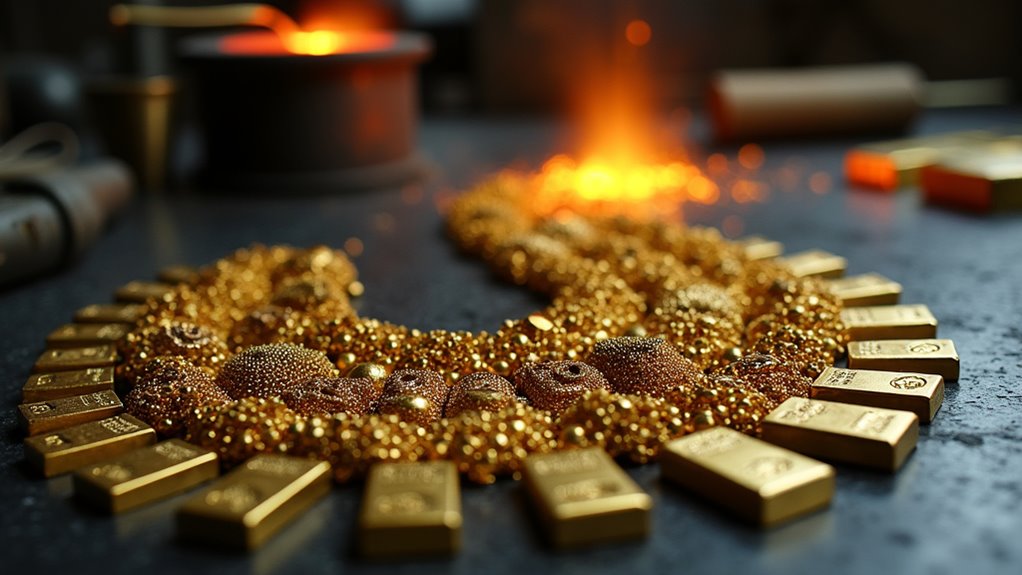
The environmental benefits of recycled gold are substantial, offering a significant reduction in resource consumption and carbon emissions compared to conventional mining operations. By repurposing existing gold from discarded jewellery and electronics, the industry minimises ecosystem disruption and prevents valuable materials from ending up in landfills. This approach aligns perfectly with the principles of circular economy, where materials are kept in use for as long as possible. Additionally, ongoing improvements in collection inefficiencies are crucial for maximizing the amount of gold that can be recycled from various sources. Furthermore, the process of recycling gold typically requires less energy than mined gold extraction, further enhancing its sustainability credentials.
Major fashion houses and jewellery brands have recognised the potential of recycled gold, with industry leaders like Pandora and Prada making firm commitments to incorporate only recycled gold in their products. This shift reflects a broader industry movement towards transparency and sustainable sourcing practises, driven by increasing consumer awareness and demand for environmentally responsible products.
Leading luxury brands embrace recycled gold, marking a significant industry shift toward sustainable and transparent practices in response to consumer demands.
The quality and purity of recycled gold remain identical to newly mined gold, offering consumers the same luxurious experience while making an environmentally conscious choice. This equivalence in quality, coupled with competitive pricing, has made recycled gold jewellery an attractive option for fashion-forward individuals who prioritise sustainability without compromising on style.
However, the industry faces several challenges that require attention. Critics have raised concerns about greenwashing, pointing to the lack of standardised definitions and strict regulations in the recycled gold sector. Additionally, while recycled gold reduces the demand for new mining, it doesn’t directly address the ongoing environmental and social issues in mining communities.
The social impact of choosing recycled gold extends beyond environmental benefits. By opting for recycled gold, consumers actively support more ethical production practices and help reduce dependence on potentially exploitative mining operations. Third-party certifications have emerged to authenticate the origins of recycled gold, providing transparency and assurance to conscious consumers.
Looking ahead, the future of recycled gold in sustainable fashion appears promising, with continued innovation and growing consumer interest driving positive change. The industry is witnessing increased efforts to establish stricter regulations and certification processes to combat greenwashing concerns. Brands are also investing in consumer education initiatives to help people understand the benefits and importance of choosing recycled gold.
The convergence of luxury and sustainability through recycled gold jewellery represents a significant step forward in the fashion industry’s journey toward environmental responsibility. As consumer awareness grows and technology advances, recycled gold continues to shine as a beacon of sustainable luxury, proving that style and environmental consciousness can coexist beautifully.
Verifying recycled gold jewellery requires checking trusted certifications like the Responsible Jewellery Council (RJC) or Recycled Content Standard.
While physical tests can confirm gold’s authenticity, they won’t reveal its recycled status.
Consumers should request documentation from brands showing their recycling processes and supply chain.
Reputable jewellers often display their certifications prominently and maintain transparency about their gold sourcing practices.
Recycled gold jewellery does not tarnish faster than regular gold jewellery. The tarnishing rate depends entirely on the karat purity and alloy metals used, not whether the gold is recycled or newly mined.
Chemically, recycled gold is identical to mined gold after proper refining. Environmental factors like humidity, chemicals and wear patterns affect both types equally.
With proper care and maintenance, both recycled and traditional gold pieces maintain their lustre for generations.
According to recent industry data, approximately 30% of gold used in jewellery manufacturing comes from recycled sources.
This percentage varies considerably by region, with Asia-Pacific leading at nearly 40% of the global scrap gold recycling market.
Major retailers like Pandora have pushed these numbers even higher, sourcing up to 97% of their gold from recycled materials.
The trend towards recycled gold continues to grow as sustainability becomes increasingly important to consumers.
Traditional gold hallmarks don’t specifically identify recycled gold pieces, as recycled gold is chemically identical to newly mined gold.
While standard hallmarks indicate purity and maker’s marks, there’s no universal system for distinguishing recycled materials.
Some jewellers voluntarily add their own markings or provide documentation to indicate recycled content, but these aren’t standardised.
Consumers typically rely on jeweller transparency and third-party certifications to verify recycled gold authenticity.
Yes, recycled gold jewellery can absolutely be melted down multiple times without any degradation in quality or purity.
Gold’s unique molecular structure means it maintains its inherent properties regardless of how many times it’s recycled.
The process involves melting the gold at high temperatures (approximately 1,064°C), removing impurities, and recasting it into new forms.
This endless recyclability makes gold one of the most sustainable precious metals available for jewellery creation.
Affiliate Disclosure: This page contains affiliate links to Amazon AU and eBay AU. We may earn a small commission if you purchase through these links, at no extra cost to you.