Affiliate Disclosure: This page contains affiliate links to Amazon AU and eBay AU. We may earn a small commission if you purchase through these links, at no extra cost to you.
As an Amazon Associate I earn from qualifying purchases.

Karat.au is an independent educational resource. The content on this site is provided for general informational purposes only and is not intended as financial, investment, legal, or taxation advice. We do not hold an Australian Financial Services Licence (AFSL), and nothing on this site constitutes a personal recommendation or a substitute for independent professional advice. You should consult a licensed financial adviser or other qualified professional before making any financial decisions.
While we strive to provide accurate and up-to-date information, we make no warranties as to its reliability, currency, or completeness. Karat.au, its authors, and contributors accept no responsibility for any loss or damage arising from reliance on the information provided. For more details, please review our Terms of Use.
Affiliate Disclosure: This page contains affiliate links to Amazon AU and eBay AU. We may earn a small commission if you purchase through these links, at no extra cost to you.
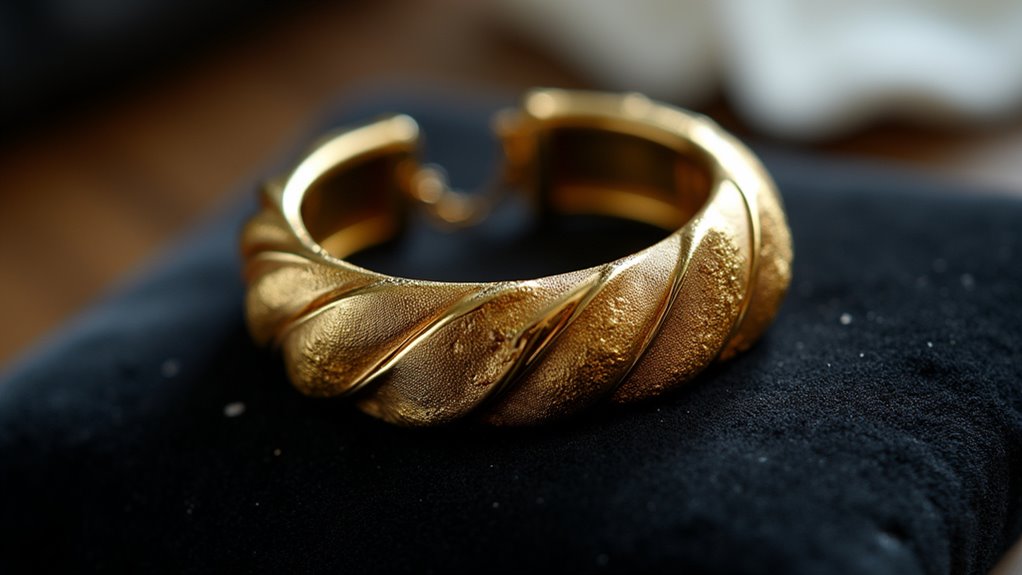
Gold quality standards vary distinctly between jewellery and investment markets. While jewellery-grade gold ranges from 8K (33.3% pure) to 22K (91.6% pure), allowing for enhanced durability through alloying, investment-grade gold requires a minimum purity of 99.9%. Cultural preferences influence jewellery standards, with Asian markets favouring 22K and Western consumers preferring 14K or 18K. Understanding these differences helps consumers navigate between ornamental and wealth preservation objectives. The world of gold quality holds many more fascinating nuances beneath the surface.

While gold has captivated humanity for millennia, its use in modern jewellery requires careful standardisation to confirm quality and value across global markets. The distinction between jewellery-grade and investment-grade gold lies not only in their purity levels but also in their practical applications and regulatory requirements.
In the jewellery sector, legal standards for gold purity vary notably worldwide. While the United States mandates a minimum of 10K (41.7% purity), European nations like Germany accept 8K (33.3% purity). These variations reflect both cultural preferences and practical considerations for everyday wear. Jewellery manufacturers must balance durability with precious metal content, leading to popular choices like 18K (75% purity) and 14K (58.5% purity) in Western markets. Additionally, the gold hallmarking process ensures that consumers can trust the purity claims made by manufacturers, which is often verified through independent testing methods. This reliance on gold purity standards is crucial for maintaining consumer confidence in the jewellery market.
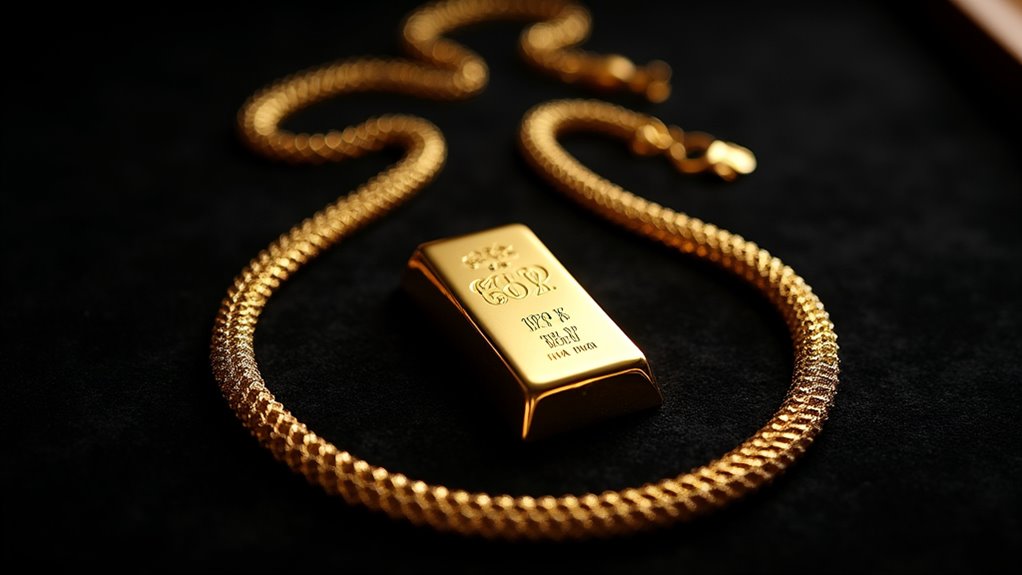
Investment-grade gold, conversely, demands much higher purity standards. Unlike jewellery, which combines gold with other metals to enhance durability and create different colours, investment products typically contain 99.9% pure gold. This distinction is essential for maintaining consistent value and fungibility in global markets. Bullion bars and coins must meet strict requirements set by international exchanges and regulatory bodies.
Cultural influences notably impact gold quality preferences in different regions. Asian markets, particularly India, favour 22K gold jewellery for its traditional value and cultural significance. Western consumers often opt for 14K or 18K pieces, prioritising durability for daily wear. These cultural nuances have shaped manufacturing standards and market availability across different regions.
The marking system for gold quality provides fundamental consumer protection and market transparency. Jewellery pieces carry stamps indicating their purity, such as ‘750’ for 18K gold, while investment-grade products display their fine gold content and manufacturer’s marks. These markings, combined with regulatory oversight, help prevent fraud and confirm consumer confidence in both sectors.
Economic considerations play an essential role in determining gold quality choices. Lower karat jewellery offers affordability for mass-market consumers, while investment-grade products command premium prices due to their higher purity. The cost of craftsmanship notably impacts jewellery prices, whereas investment products are valued primarily on their gold content and weight.
The practical implications of different gold qualities extend beyond their monetary value. Jewellery-grade gold alloys offer enhanced durability and resistance to wear, making them suitable for everyday use. In contrast, investment-grade gold’s softness makes it impractical for jewellery but ideal for storing wealth. This fundamental difference highlights why distinct quality standards exist for these two markets, each serving specific purposes in the broader gold ecosystem.
These distinctions between jewellery and investment-grade gold standards reflect the metal’s versatility in meeting diverse market needs, from adorning the body to preserving wealth. Understanding these differences enables consumers to make informed decisions based on their specific requirements, whether for personal adornment or investment purposes. Furthermore, gold purity is commonly measured using millesimal fineness, which quantifies gold content in parts per thousand.
Environmental factors have minimal direct impact on investment-grade gold‘s long-term value, as pure gold resists corrosion and chemical degradation.
However, environmental conditions can affect market dynamics through disrupted mining operations, regulatory changes, and shifting demand patterns. Natural disasters and climate-related events may influence supply chains, while environmental regulations can constrain production, potentially driving up prices.
Proper storage in climate-controlled vaults helps preserve both physical condition and value.
Yes, jewelry-grade gold can be converted to investment-grade gold through specialised refining processes.
The transformation requires melting the jewelry and using techniques like electrolysis to remove impurities and base metals, achieving a minimum purity of 99.5%.
However, this process isn’t always economically viable for small quantities, as it involves costs and potential metal loss.
Bulk refining typically offers better returns and operational efficiency.
Investment-grade gold bars and coins incorporate multiple security features for authentication. Serial numbers, hallmark logos, and laser-etched details provide unique identification.
Advanced features include micro-engraving, radial line patterns, and holographic elements. Many products now utilise Bullion DNA technology for digital verification.
Physical authentication methods like magnet tests, ultrasonic scanning, and spectrometry analysis confirm metal composition and purity. These layered security measures protect against counterfeiting.
International gold purity standards vary considerably across regions.
The United States maintains a minimum 10-karat (41.7% purity) requirement, while European nations accept lower standards between 8-9 karats (33.3-37.5%).
Asian and Middle Eastern markets favour considerably higher purities, typically 18-22 karats (75-91.6%).
These regional differences reflect cultural preferences, with Eastern markets traditionally valuing pure gold, while Western markets prioritise durability through lower-karat alloys.
Manufacturing processes greatly influence gold’s resale value across different markets.
In jewellery, intricate craftsmanship and design complexity typically command higher resale prices, particularly for handcrafted pieces.
Meanwhile, investment-grade gold benefits from standardised production methods, resulting in more predictable resale values.
The manufacturing quality, purity levels, and presence of certification all play essential roles in determining resale potential, with premium brands and trusted refiners generally maintaining stronger value retention.
Affiliate Disclosure: This page contains affiliate links to Amazon AU and eBay AU. We may earn a small commission if you purchase through these links, at no extra cost to you.