Affiliate Disclosure: This page contains affiliate links to Amazon AU and eBay AU. We may earn a small commission if you purchase through these links, at no extra cost to you.
As an Amazon Associate I earn from qualifying purchases.

Karat.au is an independent educational resource. The content on this site is provided for general informational purposes only and is not intended as financial, investment, legal, or taxation advice. We do not hold an Australian Financial Services Licence (AFSL), and nothing on this site constitutes a personal recommendation or a substitute for independent professional advice. You should consult a licensed financial adviser or other qualified professional before making any financial decisions.
While we strive to provide accurate and up-to-date information, we make no warranties as to its reliability, currency, or completeness. Karat.au, its authors, and contributors accept no responsibility for any loss or damage arising from reliance on the information provided. For more details, please review our Terms of Use.

Affiliate Disclosure: This page contains affiliate links to Amazon AU and eBay AU. We may earn a small commission if you purchase through these links, at no extra cost to you.
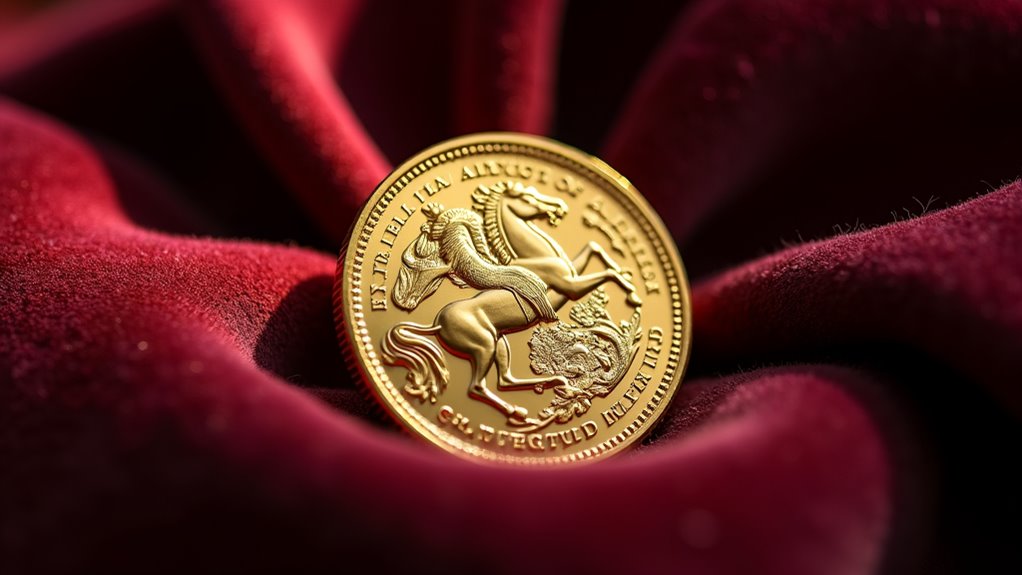
Australia’s gold coin heritage spans over 170 years, beginning with the Adelaide Pound in 1852 and Sydney Mint sovereigns in 1855. These early coins, featuring unique Australian designs and mint marks, circulated until 1931. The Perth Mint revolutionised modern Australian gold coinage with the 1986 launch of the Australian Nugget series, later showcasing the iconic kangaroo design. From historical sovereigns to contemporary nuggets, these precious pieces embody Australia’s rich mining legacy and numismatic excellence.

The glittering legacy of Australian gold coins spans more than 170 years, weaving a rich tapestry of numismatic history that began during the nation’s transformative gold rush era of the 1850s. During this period, a severe coin shortage prompted the creation of Australia’s first locally-produced gold coin, the Adelaide Pound in 1852. Though technically illegal without British approval, this pioneering piece featured a distinctive Australian design and set the foundation for the nation’s future minting endeavours.
The establishment of the Sydney Mint in 1855 marked a significant milestone in Australian coinage. The mint produced unique gold sovereigns and half-sovereigns with distinctly local designs until 1870. These early pieces proudly displayed “Sydney Mint” inscriptions, setting them apart from their British counterparts. The artistic detail in these designs further emphasizes the cultural significance of Australian coinage. Interestingly, these sovereigns were often produced using gold sourced from local mining operations, strengthening the connection between coinage and the burgeoning mining industry. This period also saw the emergence of gold coinage systems that would influence future monetary policies in Australia and beyond.
After 1870, Australian sovereigns adopted British designs but maintained their individual identity through mint marks – ‘S’ for Sydney, ‘M’ for Melbourne – identifying their origin. The sovereign, valued at £1, and its half-sovereign counterpart at 10 shillings, played an essential role in Australian commerce throughout the 19th century.
These coins continued circulation until 1931, when they were withdrawn amidst changing economic conditions. Many remaining pieces found new purpose in trade and as bullion, while others became cherished collectibles, particularly those bearing early Australian mint marks.
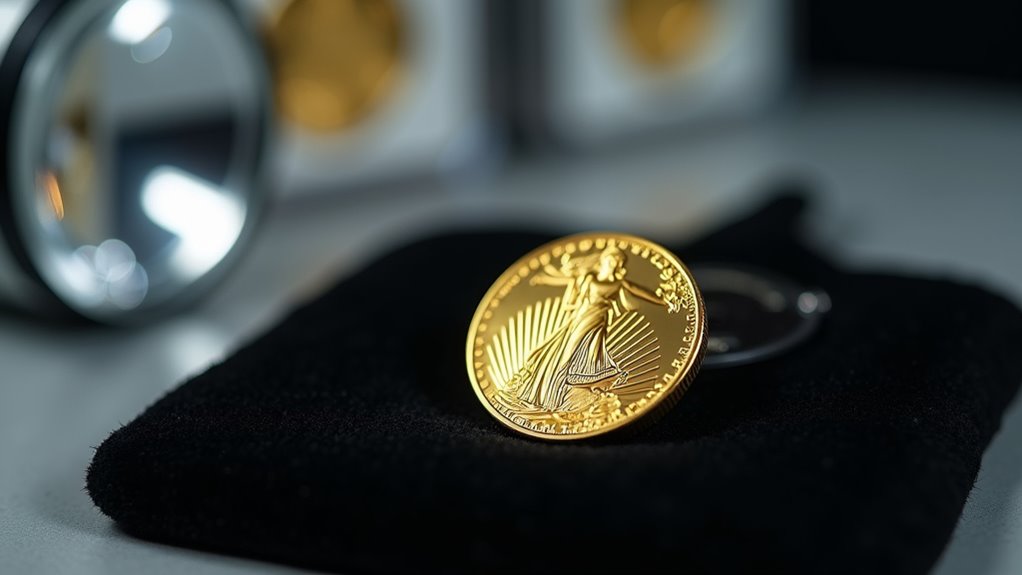
A new chapter in Australian gold coinage began in 1986 with the Perth Mint‘s introduction of the Australian Nugget coin. Initially featuring images of famous gold nuggets, the series evolved in 1989 to showcase the iconic kangaroo design. These 24-karat gold pieces, available in denominations ranging from 1/20 oz to 1 kg, quickly gained international recognition for their intricate designs and exceptional purity standards. Australia’s gold currency legacy has influenced both collectors and investors.
The Perth Mint, established in 1899, has maintained its position as a essential producer of Australian gold coins. Through innovations in striking techniques and purity standards, the mint has earned worldwide acclaim for its products, including the popular Nugget/Kangaroo series. Their commitment to quality extends to sophisticated packaging and certification processes, enhancing collector appeal and investment value.
Today, Australian gold coins represent both historical significance and modern excellence in precious metal coinage. The Adelaide Pound remains a highly sought-after piece, frequently achieving impressive prices at auction.
Early sovereigns with Australian mint marks continue to captivate collectors, while contemporary issues like the Perth Mint’s Kangaroo series attract global investors and enthusiasts alike. This enduring legacy demonstrates Australia’s significant contribution to numismatic history and its ongoing influence in the international bullion market, cementing its position as a leader in gold coin production and innovation.
Collectors can authenticate vintage Australian gold coins at home through several reliable methods.
Visual inspection under magnification reveals sharp details and proper mint marks, while weight testing using precise scales confirms authenticity.
A basic density test using water displacement helps verify gold content. Non-magnetic properties can be checked with a rare-earth magnet, and comparing dimensions against reference guides proves helpful.
However, professional authentication remains ideal for valuable pieces.
Gentle cleaning methods are essential for preserving Australian gold sovereigns. A solution of mild dish soap and distilled water is safest for lightly soiled coins.
Avoid harsh chemicals, polishes or abrasive materials that can damage the soft gold surface. Using an ultrasonic cleaner provides effective results without scrubbing.
For drying, gentle dabbing with a microfibre cloth is recommended. However, unless absolutely necessary, it’s best to leave vintage sovereigns uncleaned to maintain their value.
Several reliable sources provide accurate pricing for rare Australian Nugget coins.
BullionByPost offers current market valuations, while specialised auction houses like Noble Numismatics and Heritage Auctions maintain extensive databases of historical sales.
Professional grading services such as PCGS and NGC provide authentication and market values.
CoinArchives and Carter’s Price Guide offer detailed listings of realised prices, helping collectors assess fair market value for these sought-after pieces.
Based on current market analyses, Australian Gold Nuggets and Kangaroos are the most frequently counterfeited coins, particularly newer issues.
These are followed by historical sovereigns, which often appear as fakes on online marketplaces. Counterfeiters commonly target these pieces due to their global recognition and premium pricing.
The $2.50 and $5 gold denominations are also increasingly targeted, with sophisticated forgeries featuring tungsten cores to mimic authentic weight and density.
Environmental storage conditions greatly impact gold coin values over time.
Proper storage requires humidity levels below 50%, stable temperatures between 65-70°F, and protection from air pollutants.
Poor storage can lead to tarnishing, oxidation, and physical deterioration, diminishing both aesthetic appeal and market worth.
Individual protective capsules, climate control, and minimal handling with gloves are essential practises to maintain a coin’s condition and preserve its long-term investment value.
Affiliate Disclosure: This page contains affiliate links to Amazon AU and eBay AU. We may earn a small commission if you purchase through these links, at no extra cost to you.