

Applying circular economy principles to modern gold mining redefines sustainability in Australia’s storied industry. Mines now reprocess tailings to recover residual gold and rare metals, while closed-loop water systems cut freshwater use by up to 46%. Renewable energy, like solar at Agnew, slashes emissions, honouring our mining heritage with innovation. At Karat.au, we’re passionate about showcasing this eco-shift with factual clarity. Stick with us to uncover more on this golden transformation.
Enhancing Resource Recovery in Gold Mining

While gold minería remains a cornerstone of Australia’s rich heritage, enhancing resource recovery in modern operations is crucial for a sustainable future.
At Karat.au, we’re passionate about showcasing how innovative techniques are maximising value from every ounce of ore. Tailings reprocessing, for instance, breathes new life into waste, recovering residual gold, silver, and rare metals using methods like flotation and bioleaching. These approaches can slash tailings volume by 50-70%, embracing circular economy ideals. Moreover, greener methods such as gravity separation are gaining traction as they minimize environmental impact while efficiently extracting valuable minerals. The implementation of sustainable practices in artisanal gold mining can further enhance these recovery efforts, ensuring that communities benefit from responsible resource management. Additionally, the adoption of green technologies can significantly reduce chemical use and improve environmental outcomes in mining operations. Furthermore, the incorporation of sustainable solutions can help mitigate the ecological damage often associated with traditional mining practices.
Beyond this, advanced extraction tech, such as glycine leaching, offers lower toxicity while achieving recovery rates near 85.1%. Physical separation, like gravity methods with Knelson concentrators, targets coarse gold efficiently.

Optimising processes through real-time data and AI also boosts throughput by up to 10%. By valuing every mineral, from copper to cobalt, the industry honours Australia’s mining legacy—turning waste into wealth with ingenuity.
Crikey, that’s a golden opportunity worth celebratin’!
Sustainable Water and Energy Practices

As the gold mining industry in Australia evolves, embracing sustainable water and energy practices becomes essential for a greener future.
Innovative closed-loop water systems and advanced filtration technologies, such as reverse osmosis, are slashing freshwater use and purifying contaminated water for reuse. Tailings management with tools like E-DUC® systems boosts density, cutting water waste by up to 46%. Moreover, adopting ESG principles in operations encourages a holistic approach to sustainability. Additionally, the recycling of electronic waste from old devices can recover significant amounts of gold with minimal environmental impact. This not only mitigates the need for new mining but also contributes to a sustainable circular economy.
Cutting-edge closed-loop systems and reverse osmosis are revolutionizing water use in mining, slashing waste and purifying resources for a sustainable future.

Meanwhile, energy efficiency is prioritised—grinding processes, a major energy hog, now use high-efficiency flotation cells, trimming costs by 40%.
Renewable energy integration is transforming operations too. Mines like Agnew harness wind, solar, and battery power, while Kidston repurposes pits for pumped hydro. These hybrid solutions curb emissions and stabilise costs in remote areas. By viewing water as a resource and embedding circular principles across the mine lifecycle, the industry ain’t just reducing impact—it’s crafting a sustainable legacy for Australia’s golden heritage. Furthermore, innovations in sustainable practices are essential for meeting increasing global demand while minimizing environmental footprints.
Frequently Asked Questions
How Can Gold Mining Integrate Ecosystem Restoration Post-Closure?
Gold mining can integrate ecosystem restoration post-closure by prioritising early planning and progressive rehabilitation.
Sites should undergo thorough pre-mining assessments to set biodiversity goals, using native species for revegetation and bioengineering for soil health.

Long-term monitoring guarantees ecosystem recovery, while stakeholder engagement aligns with community values.
Water management, like restoring natural courses, is key.
Karat.au believes this approach, rooted in Aussie mining heritage, fosters sustainable landscapes for future generations.
What Are Innovative Post-Mining Land Use Options?
Innovative post-mining land use options offer fresh possibilities for repurposed mine sites.
They can transform into renewable energy hubs, like solar farms or micro-hydro plants, harnessing nature’s power.
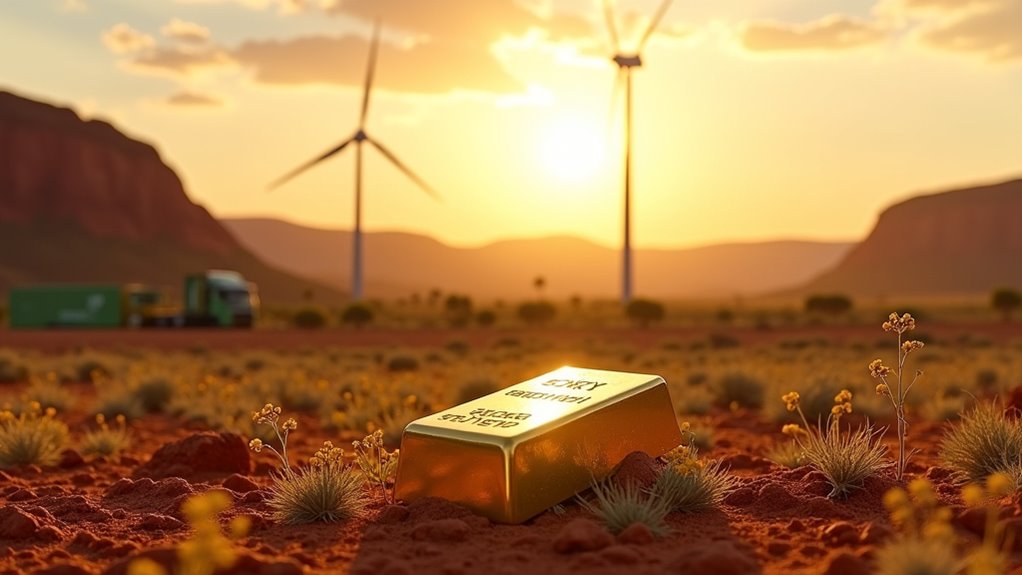
Others become recreation spots—think lakes for boating or underground museums.
Ecological restoration returns land to biodiversity, while agriculture thrives on rehabilitated soil.
Industrial reuse, such as science hubs, also emerges.
These ideas breathe new life into Australia’s mining legacy, mate.
How Does Urban Mining Complement Gold Extraction?
Urban mining complements gold extraction by tapping into human-made sources like e-waste, where gold concentrations can dwarf traditional ores.
It offers a local, sustainable supply, reducing reliance on unstable mining regions. With lower energy and water use, it curbs environmental harm while creating jobs in recycling.
Karat.au sees this as a crucial step for Australia’s gold legacy, blending innovation with heritage to meet modern demand.
What Role Does Supply Chain Collaboration Play?
Supply chain collaboration plays a pivotal role in enhancing efficiency and sustainability within the gold industry.
It enables stakeholders to optimise resource use, streamline logistics, and reduce environmental impact through shared infrastructure.

Partnerships foster innovation, driving advancements in waste reduction and material recovery.
How Can Mine Waste Be Repurposed Locally?
Mine waste can be repurposed locally in innovative ways, benefiting communities near Australian gold operations.
Tailings and waste rock may transform into construction materials like bricks or road aggregates, reducing quarrying needs. They can also become techno-soils for land rehab, boosting agriculture and biodiversity.
Additionally, recovering residual metals from waste creates economic hubs, fostering jobs.
Karat.au believes this showcases the untapped potential of mining by-products for local growth.


