Affiliate Disclosure: This page contains affiliate links to Amazon AU and eBay AU. We may earn a small commission if you purchase through these links, at no extra cost to you.
As an Amazon Associate I earn from qualifying purchases.

Karat.au is an independent educational resource. The content on this site is provided for general informational purposes only and is not intended as financial, investment, legal, or taxation advice. We do not hold an Australian Financial Services Licence (AFSL), and nothing on this site constitutes a personal recommendation or a substitute for independent professional advice. You should consult a licensed financial adviser or other qualified professional before making any financial decisions.
While we strive to provide accurate and up-to-date information, we make no warranties as to its reliability, currency, or completeness. Karat.au, its authors, and contributors accept no responsibility for any loss or damage arising from reliance on the information provided. For more details, please review our Terms of Use.

Affiliate Disclosure: This page contains affiliate links to Amazon AU and eBay AU. We may earn a small commission if you purchase through these links, at no extra cost to you.
Becoming a certified numismatist involves thorough education through organisations like the American Numismatic Association, coupled with hands-on experience in coin shops or museums. Aspiring numismatists must master coin grading, authentication, and counterfeit detection whilst building professional networks at coin shows and conventions. Though no universal certification exists, credentials from respected bodies enhance career prospects. Practical skills, historical knowledge, and strong analytical abilities are essential. The journey to numismatic expertise opens doors to fascinating opportunities in this specialised field.

While many collectors dabble in coin collecting as a hobby, becoming a certified numismatist requires dedicated study, practical experience, and professional credentials. The journey begins with establishing strong educational foundations through self-study and structured learning programs offered by respected organisations like the American Numismatic Association (ANA). These programs provide extensive knowledge in coin history, grading techniques, and currency collecting strategies, culminating in a formal Numismatic Diploma that signifies advanced proficiency in the field. Additionally, understanding the historical context of coins enhances a collector’s appreciation for numismatic significance. Furthermore, engaging in numismatic research can deepen one’s understanding of market dynamics and potential investment opportunities. Collecting gold coins also allows enthusiasts to connect with the rich history of currency, making the hobby even more rewarding.
Practical experience plays an essential role in developing the necessary skills for professional numismatics. Aspiring numismatists gain invaluable hands-on experience through employment in coin shops, internships at museums, or building their personal collections. This real-world exposure helps develop significant abilities in coin authentication, grading, and appraisal. Additionally, learning from top-rated numismatic coin shops can enhance practical skills through direct engagement with experts.
Hands-on experience through coin shops, museums, and personal collecting shapes the fundamental skills needed to master professional numismatics.
Attending coin shows, seminars, and workshops provides opportunities to network with industry professionals and stay current with market trends. Participating in events like the Numismatic Convention offers collectors a chance to learn, network, and discover new additions for their collections.
Professional organisations serve as important stepping stones in a numismatist’s career development. Membership in respected bodies like the ANA offers access to valuable resources, including specialised journals, certification programs, and mentorship opportunities. These connections often lead to career opportunities within grading firms or dealer networks, while simultaneously establishing credibility within the numismatic community.
Although there isn’t a universal certification for numismatists, several credentials demonstrate expertise in the field. The Numismatic Scholar Diploma and specialty certifications in coin grading and authentication are highly regarded. Training with prestigious organisations like the Numismatic Guaranty Company (NGC) enhances technical proficiency and increases employability, particularly in third-party grading companies.
Success in numismatics requires developing a diverse skill set. Beyond technical expertise in coin grading and identification, professionals must master counterfeit detection techniques and maintain thorough knowledge of historical coin data. Strong analytical abilities help in understanding market trends and determining accurate valuations, while excellent communication skills are essential for working with collectors and grading firms.
The career path of a certified numismatist offers diverse opportunities within the industry. Professionals may find employment with coin grading companies, auction houses, or museums. Some choose to establish their own dealerships or provide consulting services to collectors.
The field continues to evolve with technological advancements, creating new opportunities for those who maintain current knowledge and adapt their skills accordingly.
Through dedication to continuous learning and professional development, numismatists contribute to preserving numismatic heritage while building rewarding careers. Their expertise helps maintain the authenticity and proper valuation of coins, benefiting both collectors and the broader numismatic community.
Professional numismatists in the United States typically earn between $40,000 to $106,461 annually, with the national average sitting at $53,921.
The median wage is approximately $70,870, reflecting mid-career professionals.
Earnings can vary considerably based on location, with specialists in areas like San Jose, California commanding higher salaries.
Experience, certifications, and specialisation in specific areas like ancient coins can boost earnings by 20-40%.
Among the most valuable coins numismatists encounter, the 1933 Saint-Gaudens Double Eagle stands supreme, fetching $18.8 million at auction.
The 1794 Flowing Hair Silver Dollar, America’s first silver dollar, commands around $12 million.
Medieval treasures like the 1343 Edward III Florin (Double Leopard) reached $6.8 million.
Error coins also attract significant value, with the 1943 Copper Penny selling for upwards of $200,000 in pristine condition.
Numismatists absolutely require specialised insurance for their valuable collections, as standard homeowner’s policies typically provide inadequate coverage.
Collections valued over $50,000 particularly warrant dedicated insurance policies that protect against theft, damage, and mysterious disappearance.
Specialist insurers offer extensive coverage including transit protection, agreed-value policies, and expert valuation services.
These policies safeguard collections during storage, shipping, and exhibitions, whilst preventing impacts on regular home insurance premiums.
Yes, numismatists commonly specialise in specific historical periods, allowing them to develop deep expertise in particular eras of currency.
Many focus on ancient coins, such as Greek or Roman pieces, while others concentrate on medieval European coinage or colonial-era currencies.
This specialisation enables them to gain extensive knowledge of the economic, cultural and political aspects of their chosen period, making them valuable contributors to historical research and museum collections.
Numismatists employ several non-destructive techniques to authenticate coins whilst preserving their condition.
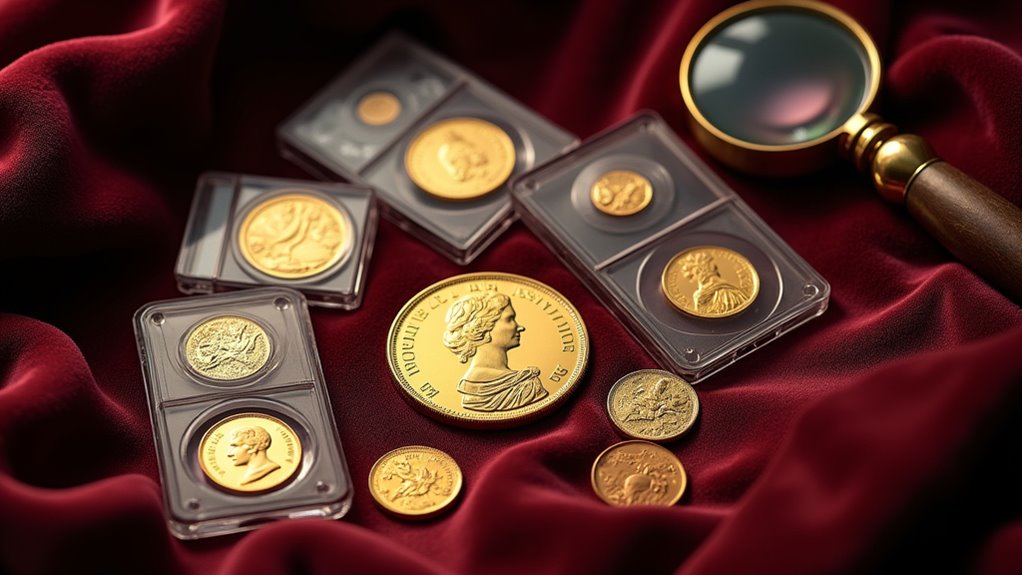
They utilise visual inspection with magnifying tools to assess details and mint marks, and conduct non-invasive scientific analysis like XRF spectroscopy to determine metal composition.
Physical assessments including specific gravity tests and gentle sound tests help verify authenticity.
Professional graders also rely on UV examination and digital imaging to detect irregularities without compromising the coin’s surface.
Affiliate Disclosure: This page contains affiliate links to Amazon AU and eBay AU. We may earn a small commission if you purchase through these links, at no extra cost to you.