Affiliate Disclosure: This page contains affiliate links to Amazon AU and eBay AU. We may earn a small commission if you purchase through these links, at no extra cost to you.
As an Amazon Associate I earn from qualifying purchases.

Karat.au is an independent educational resource. The content on this site is provided for general informational purposes only and is not intended as financial, investment, legal, or taxation advice. We do not hold an Australian Financial Services Licence (AFSL), and nothing on this site constitutes a personal recommendation or a substitute for independent professional advice. You should consult a licensed financial adviser or other qualified professional before making any financial decisions.
While we strive to provide accurate and up-to-date information, we make no warranties as to its reliability, currency, or completeness. Karat.au, its authors, and contributors accept no responsibility for any loss or damage arising from reliance on the information provided. For more details, please review our Terms of Use.

Affiliate Disclosure: This page contains affiliate links to Amazon AU and eBay AU. We may earn a small commission if you purchase through these links, at no extra cost to you.
Numismatic investing offers unique portfolio diversification through rare coins that combine historical significance with potential financial appreciation. While these tangible assets often outperform traditional investments, success requires considerable expertise in authenticity, grading standards, and market dynamics. Key factors include rarity, condition, historical importance, and precious metal content. The specialised nature of coin collecting presents both opportunities and challenges, particularly regarding liquidity and authentication. Understanding these nuances reveals the true potential of numismatic investments.

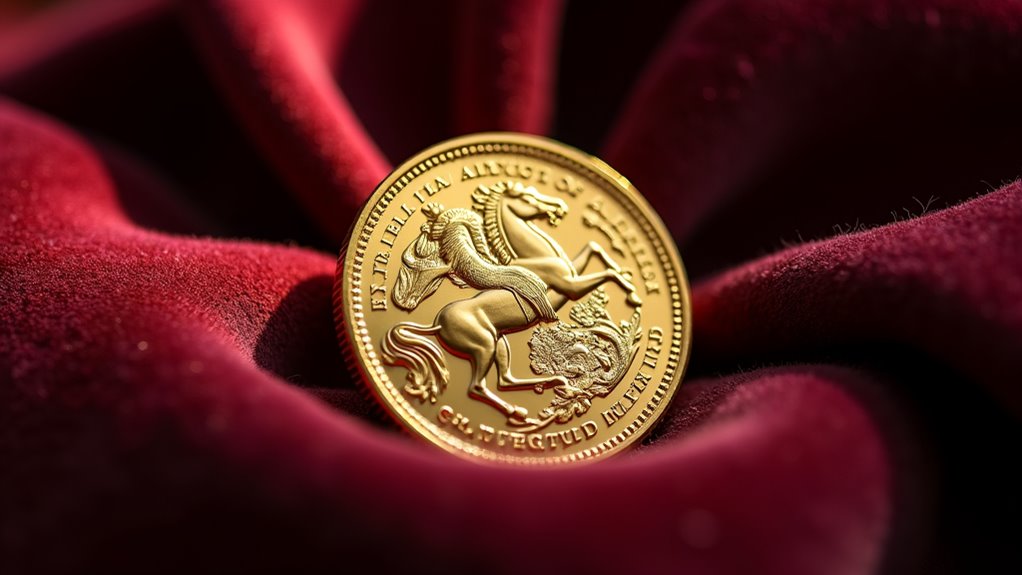
When considering alternative investment options, numismatics presents a fascinating blend of historical significance and financial potential. Collectors and investors alike are drawn to rare coins not only for their monetary value but also for their ability to capture moments in history through meticulously crafted designs and precious metal content. The appeal of numismatics extends beyond mere collecting, as these tangible assets have demonstrated impressive long-term appreciation, often outperforming traditional investment vehicles. Additionally, collecting gold coins can serve as a gateway to understanding the broader context of economic history. Recent studies indicate that the best platforms for rare coin trading can significantly enhance the buying and selling experience for investors. Furthermore, obtaining numismatist certification can provide valuable insights and credibility in the market. Furthermore, the fascination with gold coinage throughout history underscores its enduring value and significance.
The investment potential of numismatic coins is rooted in several key characteristics that distinguish them from conventional assets. Unlike stocks or digital investments, rare coins offer physical possession and a unique combination of intrinsic metal value and collectible premium. Historical data suggests that well-chosen numismatic pieces have delivered superior returns compared to real estate, equities, and even gold bullion. This performance is largely attributed to the limited availability of specific coins and growing demand from enthusiasts worldwide.
Physical ownership combined with intrinsic metal value makes numismatic coins uniquely positioned to outperform traditional investment vehicles over time.
However, prospective investors should carefully weigh the challenges inherent in numismatic investing. The market demands considerable expertise to navigate successfully, with substantial markups being commonplace. Authentication poses a significant concern, as counterfeit coins continue to plague the market. Additionally, the specialised nature of rare coin trading can result in reduced liquidity, making it potentially difficult to sell pieces quickly without compromising on price.
The value of numismatic coins is influenced by a complex interplay of factors. Rarity stands as the primary driver, with coins of limited mintage or unique characteristics commanding premium prices. The condition of a coin, professionally graded by recognised organisations, plays a vital role in determining its worth. Historical significance and artistic merit further enhance desirability, while the underlying precious metal content provides a foundation of intrinsic value. Additionally, coins like ancient gold coins represent some of the most sought-after pieces in the numismatic world, due to their rarity and historical importance.
Long-term success in numismatic investing typically requires patience and dedication to market education. Investors must develop a thorough understanding of grading standards, authenticity markers, and market trends. While short-term speculation can be risky, carefully selected coins have demonstrated remarkable stability and appreciation over extended periods, particularly those with compelling historical narratives or exceptional artistic merit.
The diversification benefits of numismatics shouldn’t be overlooked in an investment portfolio. These tangible assets operate independently of traditional financial markets, potentially offering protection during periods of economic uncertainty. While the market may experience fluctuations in popularity and demand, the enduring appeal of rare coins, combined with their finite supply, suggests continued potential for long-term value appreciation.
Nevertheless, investors should approach numismatics with realistic expectations, recognising that success requires careful research, authentication, and a willingness to hold assets for extended periods.
Collectors should maintain ideal humidity levels between 30-50% using silica gel packs and dehumidifiers.
Temperature control is essential – store coins in cool, stable environments away from direct sunlight.
Use inert materials like polypropylene holders and handle coins with cotton gloves to prevent oil transfer.
Keep storage areas free from pollutants and chemicals whilst ensuring proper air quality.
Regular monitoring with humidity metres helps maintain optimal conditions for preserving valuable collections.
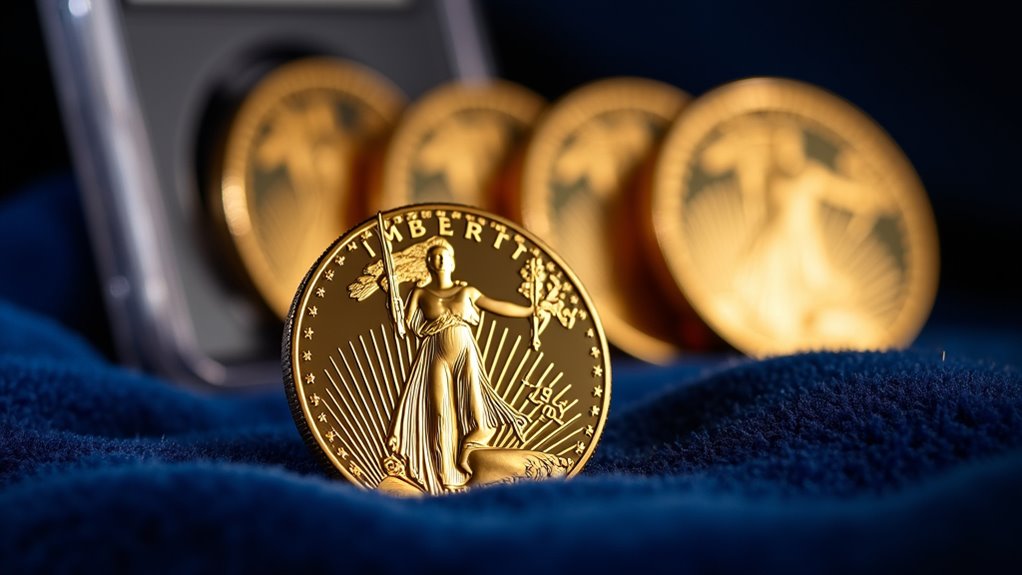
PCGS and NGC stand as the most trusted grading services in the numismatic community, with PCGS particularly respected for U.S. coins and NGC excelling in world coin authentication.
CAC provides additional verification by ‘stickering’ high-quality specimens from both services.
While preferences vary among collectors, PCGS-graded coins often command premium prices in the market, especially for rare American specimens.
NGC’s expertise in world coinage makes it equally trusted internationally.
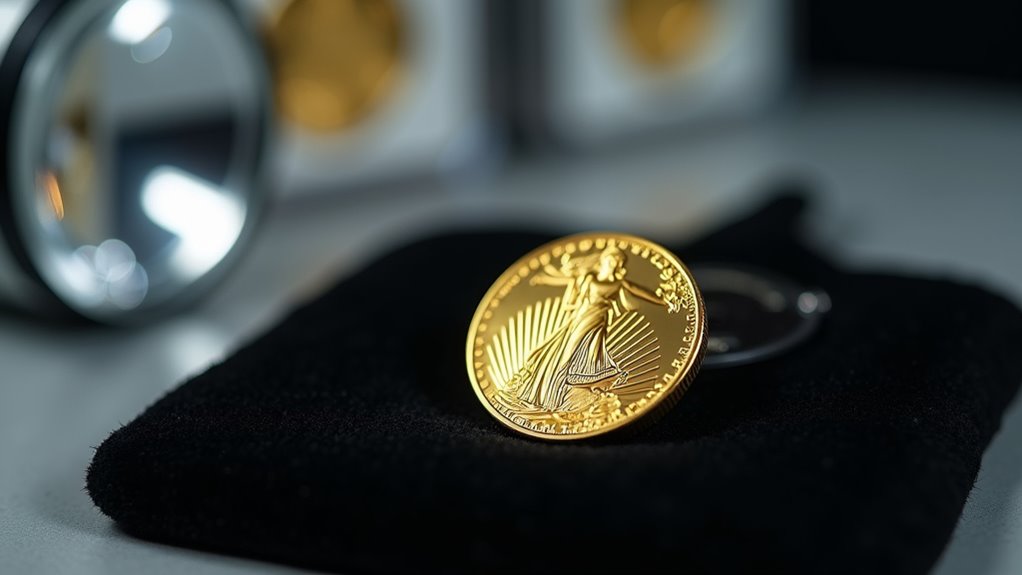
Essential tools for professional coin examination include a quality 10x magnifier with LED lighting, precision digital scales, and accurate calipers for authentication.
Protective cotton gloves and acid-free holders prevent damage during handling. A USB microscope (20-40x) helps detect counterfeits and assess condition.
Reference materials and UV lights aid verification. For serious collectors, professional grading guides and catalogues are invaluable resources for accurate assessment.
The value comparison between ancient and modern rare coins isn’t straightforward.
While ancient coins carry significant historical and cultural worth, modern rare coins often command higher prices due to their precise minting, purity standards, and market accessibility.
Ancient coins’ value stems from historical significance and scarcity, whereas modern rare coins benefit from controlled production and broader market appeal.
Each category’s worth ultimately depends on specific factors like condition, rarity, and collector demand.
Spotting counterfeit coins requires careful examination of several key elements.
Collectors should assess the coin’s visual characteristics, including design irregularities, edge details, and surface imperfections.
Weight and dimension testing using precise scales and calipers helps verify authenticity against official specifications.
Material composition analysis through XRF spectrometry can confirm proper metal content, whilst advanced technology like 3D imaging may reveal subtle manufacturing flaws that indicate counterfeiting.
Affiliate Disclosure: This page contains affiliate links to Amazon AU and eBay AU. We may earn a small commission if you purchase through these links, at no extra cost to you.