Affiliate Disclosure: This page contains affiliate links to Amazon AU and eBay AU. We may earn a small commission if you purchase through these links, at no extra cost to you.
As an Amazon Associate I earn from qualifying purchases.

Karat.au is an independent educational resource. The content on this site is provided for general informational purposes only and is not intended as financial, investment, legal, or taxation advice. We do not hold an Australian Financial Services Licence (AFSL), and nothing on this site constitutes a personal recommendation or a substitute for independent professional advice. You should consult a licensed financial adviser or other qualified professional before making any financial decisions.
While we strive to provide accurate and up-to-date information, we make no warranties as to its reliability, currency, or completeness. Karat.au, its authors, and contributors accept no responsibility for any loss or damage arising from reliance on the information provided. For more details, please review our Terms of Use.

Affiliate Disclosure: This page contains affiliate links to Amazon AU and eBay AU. We may earn a small commission if you purchase through these links, at no extra cost to you.
Collecting gold coins chronologically reveals fascinating insights into human civilisation, from King Croesus’s first coins in 6th century BC Lydia through to modern bullion pieces. The journey spans ancient Greek and Roman masterpieces, medieval European florins, Spanish doubloons from the Age of Exploration, and 19th-century sovereigns minted during major gold rushes. Today’s collectors often focus on investment-grade commemoratives and bullion coins, with each era offering unique historical significance and artistic merit. The deeper one explores, the richer the numismatic treasures become.

While gold has captivated humanity for millennia, the history of gold coins represents one of civilisation’s most fascinating journeys through wealth, power, and artistic expression. The story begins in ancient Anatolia, where King Croesus of Lydia introduced the first gold coins in the 6th century BC. These early pieces, often mixed with silver in an alloy called electrum, paved the way for more refined coinage. The use of ancient gold coins initiated a long-standing tradition of currency that would evolve over centuries.
Gold’s journey from ancient Lydia to modern times reveals humanity’s enduring fascination with this precious metal’s beauty and power.
The Greeks and Romans later elevated coin design to an art form, incorporating intricate details that both deterred counterfeiting and celebrated their cultures.
The Medieval period witnessed a significant evolution in gold coinage, with the Byzantine solidus and Islamic dinar emerging as dominant currencies. European cities like Florence and Venice made their mark with the introduction of the florin and ducat, while African gold from Mali enriched the continent’s monetary system.
To combat the practice of “clipping,” increasingly sophisticated designs were developed, though silver and bronze remained the primary metals for everyday transactions.
The Age of Exploration ushered in a golden era for coin production. As Spanish and Portuguese ships returned laden with New World treasure, iconic coins like the doubloon and guinea gained international recognition. These pieces weren’t merely currency; they served as powerful symbols of national prestige, often featuring royal portraits and elaborate heraldic designs that spoke to the emerging global economy.
The 19th century brought unprecedented changes to gold coinage, sparked by major discoveries in California, Australia, and South Africa. The establishment of the gold standard created a more stable international monetary system, while technological advances in minting produced coins of exceptional consistency.
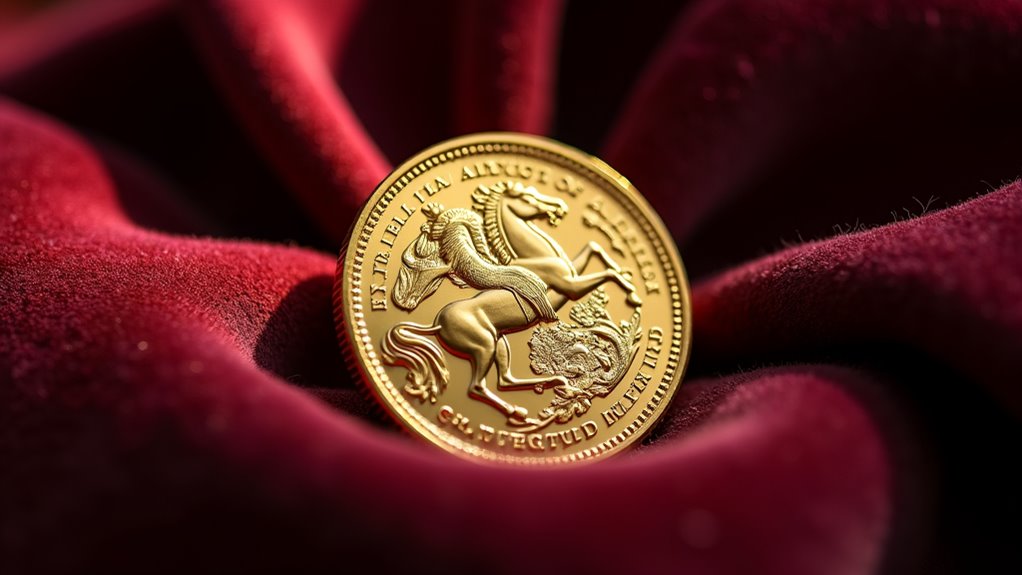
The U.S. Double Eagle and British sovereign became standout examples of this new era’s achievements in numismatic excellence.
The 20th century marked a dramatic shift in gold coin production. The Great Depression and subsequent restrictions on private gold ownership, particularly in the United States after 1933, transformed the landscape of gold coinage.
Production pivoted towards bullion and commemorative pieces, with nations focusing on investment-grade products rather than circulation currency.
In the modern era, bullion coins have become the primary focus of gold coin production. The South African Krugerrand‘s introduction in 1967 established a template that other nations would follow. Top gold coins worth investing in today showcase the evolution of these modern pieces, which combine precise minting techniques with stunning designs, continuing the ancient tradition of marking human achievement in precious metal while adapting to contemporary market demands.
Gold coins should be stored in PVC-free capsules or acid-free holders within a climate-controlled environment.
Maintaining stable temperature and humidity levels is essential, while using dehumidifiers or silica gel packets helps prevent oxidation.
Handling coins with cotton gloves or tweezers protects against skin oils and damage.
For ultimate protection, consider a moisture-resistant safe or bank deposit box, and regularly inspect coins for signs of environmental deterioration.
NGC Ancients stands as the most trusted authentication service for ancient gold coins, with their expert-led team providing thorough grading and encapsulation.
PCGS Gold Shield offers advanced technological verification, including AI detection and NFC security.
While David Sear Certification provides respected authentication without grading, it’s advisable to combine dealer guarantees with third-party authentication from NGC or PCGS for ideal security when acquiring ancient gold pieces.
Generally, cleaning collected gold coins is not recommended as it can greatly reduce their value, particularly for collectible or antique pieces.
The natural patina that develops over time is often desirable to collectors and contributes to authenticity.
However, if cleaning is absolutely necessary due to severe contamination, use only mild soap and distilled water, avoiding harsh chemicals or abrasive materials.
The safest approach is proper storage to prevent the need for cleaning altogether.
Reputable gold coin dealers specialising in specific eras can be found through several channels.
National dealers like APMEX and JM Bullion offer extensive catalogues of period-specific coins, while specialised merchants such as Stack’s Bowers excel in ancient coinage.
The NGC Coin Dealer Locator tool helps collectors find verified dealers by era and location.
Local establishments in major cities, like Chicago Coin Company and Beverly Hills Precious Metals, also provide era-focused collections.
Mintmark variations greatly influence historical gold coin values, with rarer mintmarks typically commanding higher prices.
Coins from low-production mints, like Carson City, are particularly valuable. Weak or poorly struck mintmarks, such as the 1911-D Indian Head Gold Eagle, often attract premium prices.
The presence or absence of mintmarks can create considerable value differences, while unique variations and errors further enhance collectibility and market worth.
Affiliate Disclosure: This page contains affiliate links to Amazon AU and eBay AU. We may earn a small commission if you purchase through these links, at no extra cost to you.