Affiliate Disclosure: This page contains affiliate links to Amazon AU and eBay AU. We may earn a small commission if you purchase through these links, at no extra cost to you.
As an Amazon Associate I earn from qualifying purchases.

Karat.au is an independent educational resource. The content on this site is provided for general informational purposes only and is not intended as financial, investment, legal, or taxation advice. We do not hold an Australian Financial Services Licence (AFSL), and nothing on this site constitutes a personal recommendation or a substitute for independent professional advice. You should consult a licensed financial adviser or other qualified professional before making any financial decisions.
While we strive to provide accurate and up-to-date information, we make no warranties as to its reliability, currency, or completeness. Karat.au, its authors, and contributors accept no responsibility for any loss or damage arising from reliance on the information provided. For more details, please review our Terms of Use.

Affiliate Disclosure: This page contains affiliate links to Amazon AU and eBay AU. We may earn a small commission if you purchase through these links, at no extra cost to you.
The BRICS proposal for a gold-backed reserve currency represents an ambitious yet complex undertaking. While the initiative aims to challenge US dollar dominance through collective gold reserves of 5,700 tonnes, significant hurdles exist. Technical challenges include logistics of gold management, economic disparities among member nations, and potential inflexibility during market volatility. Though the concept holds transformative potential for global trade, its practical implementation remains uncertain. The full story reveals fascinating implications for the future of international finance.

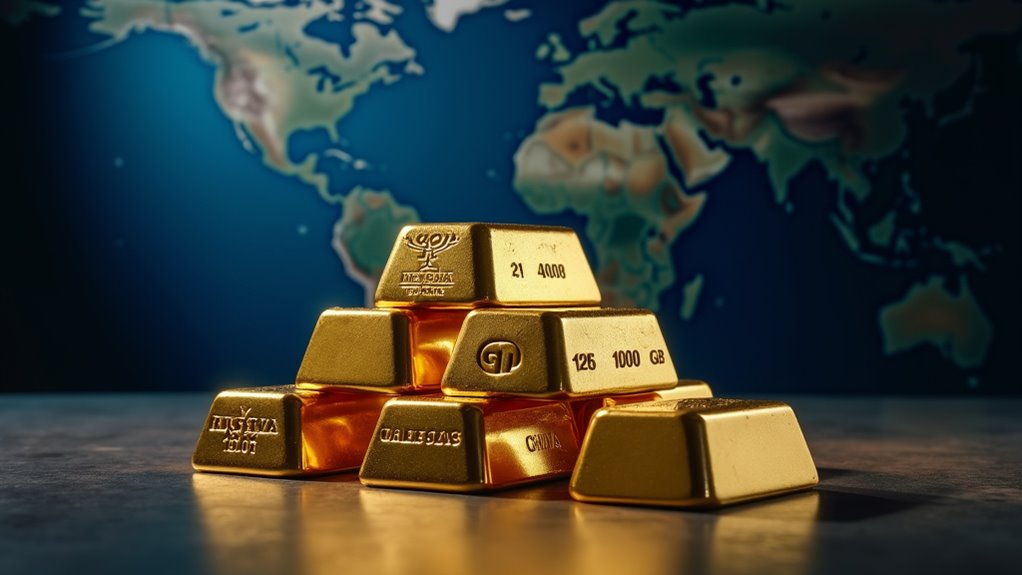
As global economic powers continue to shift, BRICS nations have revealed an ambitious proposal to establish a new reserve currency backed by gold, marking a significant challenge to the US dollar‘s long-standing dominance in international trade. The collective strength of Brazil, Russia, India, China, and South Africa, which together hold approximately 5,700 tonnes of gold—representing 16% of global reserves—positions them uniquely to pursue this transformative initiative. Top countries by gold reserves** indicate that these nations are among the most significant holders of this precious metal, enhancing their bargaining power on the global stage. The rising interest in sustainable gold** practices highlights a broader trend that could influence the valuation of gold as a stable asset.
The concept centres on creating a stabilised currency underpinned by physical gold reserves, potentially structured as a basket currency incorporating gold alongside other strategic assets. This approach aims to reduce reliance on the US dollar while fostering economic independence among BRICS nations. The rationale stems from gold’s historical credibility as a stable asset, particularly during periods of economic uncertainty. Additionally, many countries are increasing their gold reserves as a hedge against economic crises and inflation fears. To facilitate this initiative, BRICS will need to address existing challenges, including overcoming challenges in gold recycling to ensure a sufficient supply of gold for their currency.
However, the path forward isn’t without significant hurdles. Critics point to the practical difficulties faced by previous gold-backed currencies, particularly their inherent inflexibility during economic shocks. The disparate economic realities among BRICS members present additional challenges for implementation and long-term sustainability. Questions remain about the logistics of gold acquisition, storage, and distribution across these nations.
The implications for global markets could be far-reaching. A successful launch might trigger increased gold demand, potentially driving prices upward and affecting investment vehicles like Gold IRAs. The initiative could also lead to reduced demand for US Treasuries, impacting the US dollar’s value. Meanwhile, other nations might boost their gold reserves to stabilise their own currencies in response.
The strategic significance extends beyond economics. This initiative represents an opportunity for BRICS to strengthen their geopolitical influence while reducing vulnerability to Western sanctions. It encourages new alliances with countries seeking alternatives to dollar-denominated trade and reinforces the trend toward regional economic blocs and decentralised trade mechanisms.
Western economies and institutions have expressed scepticism, highlighting concerns about liquidity constraints and the potential for speculative attacks due to fixed valuation metrics. Yet, the proposal’s alignment with the broader push toward multipolarity in global finance suggests it shouldn’t be dismissed outright.
The success of this endeavour will likely depend on the BRICS nations’ ability to overcome operational challenges while maintaining economic stability. Whether fact or fiction, the mere proposal has already sparked important discussions about the future of global reserve currencies and the role of gold in international finance.
As this initiative develops, its impact on the global monetary system and gold markets will continue to be closely monitored by economists, investors, and policymakers worldwide.
BRICS nations would likely employ a hybrid approach to gold transfers between central banks.
Physical transfers would utilise secure vault-to-vault methods with specialised armoured transport and strict security protocols.
However, modern transfers increasingly rely on tokenised gold using blockchain technology, where digital units represent physical holdings.
This reduces logistical risks and costs while maintaining transparency through distributed ledger systems and regular third-party audits of physical reserves.
Cryptocurrencies could serve multiple essential functions within a BRICS gold-backed currency system. They’d potentially facilitate rapid cross-border settlements using blockchain technology, reducing dependence on traditional banking networks.
Digital tokens might represent fractional gold reserves, enabling precise transactions. Additionally, crypto infrastructure could enhance the system’s decentralisation whilst providing member nations a mechanism to bypass conventional payment systems.
However, regulatory challenges and security risks would need careful consideration.
Sanctions greatly impede the implementation of a BRICS reserve currency by disrupting essential financial mechanisms.
Trade restrictions limit member nations’ ability to establish necessary infrastructure, while reduced access to global markets hampers currency adoption.
Banking limitations and frozen foreign reserves complicate the system’s liquidity requirements.
Additionally, varying sanction regimes across BRICS members create operational challenges for unified implementation, particularly affecting cross-border payment systems and gold valuation processes.
Non-BRICS nations can potentially participate in the new monetary system through established partnerships and agreements.
Countries would need to meet specific requirements, including adequate gold reserves and compatible financial infrastructure.
While participation offers benefits like reduced dollar dependency and enhanced trade stability, nations must carefully weigh diplomatic implications with Western allies.
Several countries, including Saudi Arabia and UAE, have already shown interest in joining the framework.
Based on current economic analyses, BRICS member countries would likely need to maintain gold reserves of approximately 20-30% of their total foreign exchange reserves to adequately back a new currency system.
For larger economies like China and Russia, this could mean holdings of 3,000-4,000 metric tonnes each, whilst smaller members might require 500-1,000 metric tonnes.
However, these figures remain speculative as no official requirements have been established.
Affiliate Disclosure: This page contains affiliate links to Amazon AU and eBay AU. We may earn a small commission if you purchase through these links, at no extra cost to you.