Affiliate Disclosure: This page contains affiliate links to Amazon AU and eBay AU. We may earn a small commission if you purchase through these links, at no extra cost to you.
As an Amazon Associate I earn from qualifying purchases.

Karat.au is an independent educational resource. The content on this site is provided for general informational purposes only and is not intended as financial, investment, legal, or taxation advice. We do not hold an Australian Financial Services Licence (AFSL), and nothing on this site constitutes a personal recommendation or a substitute for independent professional advice. You should consult a licensed financial adviser or other qualified professional before making any financial decisions.
While we strive to provide accurate and up-to-date information, we make no warranties as to its reliability, currency, or completeness. Karat.au, its authors, and contributors accept no responsibility for any loss or damage arising from reliance on the information provided. For more details, please review our Terms of Use.

Affiliate Disclosure: This page contains affiliate links to Amazon AU and eBay AU. We may earn a small commission if you purchase through these links, at no extra cost to you.
Gold profoundly transformed the Age of Exploration, driving European powers to seek wealth through ambitious expeditions to the Americas. The Spanish conquest of Aztec and Inca empires, fuelled by gold fever, established new trade routes and maritime innovations whilst devastating indigenous populations. This precious metal catalysed the development of banking systems, shaped colonial policies, and forged complex geopolitical relationships between nations. The story of gold’s influence extends far beyond mere economic value.

The glitter of gold cast a transformative shadow across the Age of Exploration, forever altering the course of human civilisation. European powers, driven by an insatiable appetite for wealth and dominance, initiated countless expeditions across vast oceans in pursuit of this precious metal. The promise of gold not only fueled their economic ambitions but also catalysed the development of sophisticated banking systems and financial institutions throughout Europe. In times of geopolitical tension, the value of gold often surged as nations sought stability through investment in this enduring asset, leading to a strategic focus on increased gold reserves as a means of securing economic strength. Moreover, many countries recognized gold’s role in national reserves, leveraging their holdings to bolster financial security and maintain economic stability. The potential for a gold-backed currency among nations today echoes the historical importance of gold in shaping economic systems.
The discovery of gold in the Americas marked a significant moment in history, sparking a rapid colonisation effort that would reshape the global landscape. Spanish conquistadors, enticed by tales of endless riches in the Aztec and Inca empires, set out on brutal campaigns of conquest. These endeavours established an extensive network of colonies, with gold extraction becoming the cornerstone of Spanish imperial wealth through the notorious encomienda system.
Spanish thirst for gold unleashed devastating conquest across the Americas, forever transforming both colonial power and indigenous civilizations through systematic exploitation.
The pursuit of gold extracted a devastating toll on indigenous communities throughout the Americas. Native populations faced unprecedented hardships as they were forced into treacherous mining operations, while European diseases decimated their numbers. Traditional societal structures crumbled under the weight of colonial exploitation, and attempts at resistance were met with severe reprisals, forever altering the cultural fabric of these ancient civilisations.
Gold’s influence extended far beyond the Americas, becoming an essential medium of exchange in global trade networks. European nations leveraged their newly acquired wealth to establish profitable trade relationships with Asia, particularly in the commerce of luxury goods like silk and spices. This influx of gold strengthened maritime routes and laid the groundwork for early globalisation, connecting continents in ways previously unimaginable.
The allure of gold drove exploration to new heights, with legendary tales such as El Dorado inspiring countless expeditions into uncharted territories. Explorers, incentivised by royal promises of wealth and status, pushed the boundaries of known navigation. Even Christopher Columbus’s famous voyages were partially motivated by the prospect of discovering gold-rich lands, leading to significant advancements in maritime technology and cartography.
The scramble for gold triggered intense rivalry among European powers, fundamentally reshaping geopolitical relationships. Spain’s access to New World gold catapulted it to the position of a dominant global power, while other nations competed fiercely for control over gold-rich territories. These power struggles influenced colonial policies and international relations, creating alliances and enmities that would persist for centuries.
Through this transformative period, gold emerged as more than just a precious metal – it became a catalyst for exploration, technological innovation, and cultural exchange, albeit often through tragic means. Its influence reshaped global power structures, established new economic systems, and irreversibly altered the course of human history, leaving an indelible mark on our modern world. Moreover, the eventual shift to the gold standard in currency systems reflected the lasting legacy of gold’s economic significance.
Indigenous cultures across the Americas held vastly different perspectives on gold.
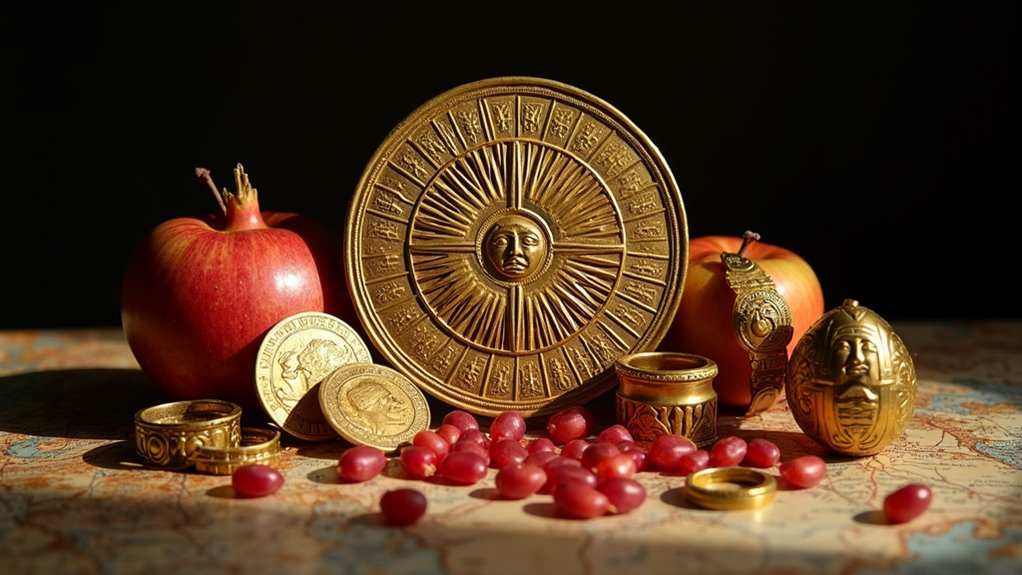
South American and Mesoamerican societies viewed it as spiritually significant, crafting sophisticated ceremonial objects and developing advanced metallurgical techniques. The Inca considered it the “sweat of the gods,” while Aztecs linked it to solar deities.
In contrast, North American tribes largely disregarded gold, focusing instead on practical materials like obsidian and maintaining sustainable resource practices.
During the Age of Exploration, traders and explorers relied primarily on three methods to verify gold’s authenticity.
The fire assay method, though destructive, provided accurate purity measurements by melting samples with lead oxide.
The Archimedes’ method utilised water displacement to determine density, whilst acid testing involved scratching gold against stones and applying specific acids to observe chemical reactions.
These techniques helped prevent fraud in precious metal transactions.
Gold transportation markedly influenced shipbuilding during the Age of Exploration.
Vessels required extensive modifications, including reinforced hulls and enhanced ballast systems to manage heavy precious metal cargo. Ships grew larger, featuring multiple decks and armoured compartments for secure storage.
Defence capabilities were bolstered with additional cannons and watchtowers to protect valuable shipments.
Navigation innovations, such as improved sails and rudders, guaranteed safer passage of these precious cargoes across vast oceans.
Gold served as a powerful diplomatic tool, facilitating alliances and trade agreements between nations. It functioned as both a universal currency and a prestigious gift, strengthening relationships through tribute payments and ceremonial exchanges.
European powers competed intensely for gold-rich territories, leading to treaties like Tordesillas in 1494. The precious metal’s economic and symbolic value made it central to international negotiations, particularly in establishing colonial partnerships and resolving territorial disputes.
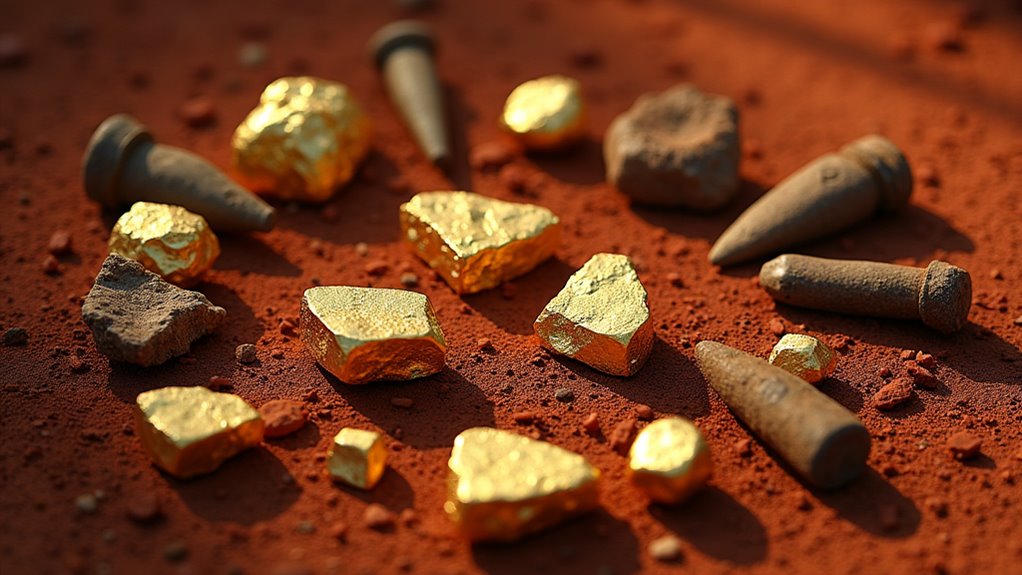
During the Age of Exploration, gold mining techniques evolved markedly from basic manual methods to more sophisticated processes.
The Spanish introduced the ‘arrastre’ system, where animals or water power ground rocks in circular motion. Mercury amalgamation became widespread, despite its hazards. Indigenous labour was exploited to expand operations, while innovations like rockers and cradles improved efficiency.
Colonial powers refined hydraulic and placer mining techniques, establishing larger-scale extraction methods throughout the Americas.
Affiliate Disclosure: This page contains affiliate links to Amazon AU and eBay AU. We may earn a small commission if you purchase through these links, at no extra cost to you.