

Gold formed the bedrock of Roman economic power, driving their monetary system through coins like the aureus and solidus. The Empire’s innovative mining techniques at sites like Las Médulas revolutionised gold extraction, while strict regulations governed its purity and distribution. These Roman principles continue to influence modern gold markets, standardisation practices, and resource management. Their organisational genius in managing precious metals offers valuable insights into today’s monetary frameworks.

Gold in the Roman Empire
Throughout the expansive Roman Empire, gold served as the bedrock of economic power and cultural prestige, fundamentally shaping the ancient world’s most formidable civilisation. The Romans’ masterful exploitation of gold resources, particularly from regions like Hispania and Dacia, demonstrated their exceptional engineering capabilities and administrative prowess. At Las Médulas, they pioneered large-scale hydraulic mining techniques that would influence mining practices for centuries to come and established a strong foundation for future monetary gold standards. This emphasis on gold extraction and processing also laid early groundwork for gold recycling, which has become crucial in modern sustainability efforts. The Romans’ extensive reach in acquiring gold from various territories also contributed to the global gold mining market that we recognize today. Furthermore, their mining practices laid the foundation for the modern understanding of gold reserves, which continue to be critical in global economies today.
The Romans’ sophisticated monetary system centred around gold coinage, with the aureus and later the solidus forming the backbone of their economy. These coins, valued at 25 silver denarii, facilitated trade across vast territories and even reached distant lands like India and China. The discovery of substantial hoards, such as the remarkable Bray Shallow Horde containing 80,000 coins, illustrates the immense scale of Roman gold circulation.

The Empire’s economic might was intrinsically linked to its gold reserves, though this reliance occasionally proved problematic. Annual tribute payments, including the hefty 350-pound gold payment to the Huns, strained imperial finances. Nevertheless, gold’s role in tax collection and state expenses, particularly military payments, remained essential throughout Roman history. The eventual shift towards a gold-dominated currency system, following silver’s debasement, highlighted gold’s enduring value as a monetary standard.
Rome’s reliance on gold proved both a blessing and burden, funding its empire while draining resources through costly tribute payments.
Roman society’s relationship with gold extended beyond mere economics. The precious metal adorned temples, statues, and private residences, symbolising both divine favour and earthly success. Wealthy Romans displayed their affluence through gold jewellery, plateware, and decorative arts, while religious institutions incorporated gold into votive offerings and ceremonial objects. Even in death, gold maintained its significance, frequently appearing in burial sites as funerary goods.
The administration of gold resources reflected Rome’s organizational genius. The imperial treasury (fiscus) maintained centralised control over gold production and distribution, while provincial authorities managed extraction operations under military supervision. Strict regulations governing weight and purity guaranteed the integrity of the Empire’s monetary system, establishing standards that would influence future civilisations.
The Romans’ sophisticated approach to gold mining, monetary policy, and resource management established precedents that continue to resonate in modern times. Their engineering achievements in extraction methods, particularly at sites like Las Médulas, laid the groundwork for contemporary mining techniques. Additionally, the use of AI-driven prospecting in modern gold mining echoes the Romans’ innovative spirit in resource management.
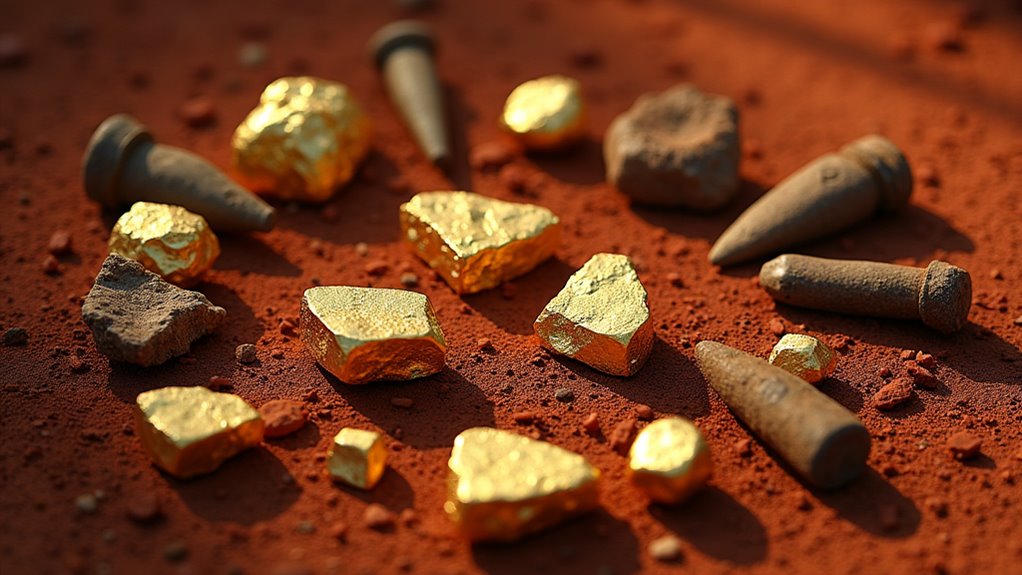
The Empire’s use of gold as a stable currency and store of value mirrors today’s monetary systems, while their regulatory frameworks for maintaining gold’s purity and weight echo current standardisation practices. This ancient legacy demonstrates how Roman innovation in gold management and utilisation has shaped our modern understanding and application of this precious metal.
Frequently Asked Questions
How Did Romans Test for Gold Purity Without Modern Technology?
Romans employed several sophisticated methods to test gold purity.
The touchstone technique involved comparing gold streaks against reference samples, while fire assays melted gold to separate impurities with remarkable accuracy.
They also utilised acid testing, where nitric acid was applied to detect base metals through chemical reactions.

Visual inspection and hallmarking provided additional verification, with official stamps certifying authenticity and purity in trade.
What Happened to Rome’s Gold Reserves After the Empire Fell?
Rome’s gold reserves dispersed widely following the empire’s collapse in the 5th century CE.
Large portions flowed eastward to India through trade routes, while significant amounts were looted during barbarian invasions, particularly the Visigoth’s sack of Rome in 410 CE.
The remaining gold became concentrated among elites and emerging kingdoms.

The Byzantine Empire maintained control of some reserves, while Islamic Caliphates acquired portions through territorial expansion and trade.
Did Romans Use Gold for Medical Treatments Like Some Ancient Civilizations?
Romans indeed used gold extensively in their medical practices.
They employed gold-based treatments for various ailments, including warts, fistulas and haemorrhoids, as documented by Pliny the Elder.
Gold surgical instruments were favoured for their non-corrosive properties, while dissolved gold solutions were used in medicinal preparations.

The precious metal’s perceived magical and protective qualities also influenced its medical applications, though its effectiveness was largely based on cultural beliefs rather than scientific evidence.
How Did Roman Gold Coins Influence Medieval European Currency Systems?
Roman gold coins profoundly shaped medieval European currency systems. The Roman aureus and later solidus established essential standards for weight, purity, and design that medieval mints adopted.
Their influence extended to centralised minting practices, the use of ruler portraits, and Latin inscriptions. When medieval states like Florence reintroduced gold coinage in the 13th century, they drew heavily from Roman precedents, particularly in maintaining high-quality standards and facilitating international trade.
Were There Any Legendary Roman Gold Mines That Remain Undiscovered Today?
Several legendary Roman gold mines remain undiscovered, particularly in Spain’s remote León and Eria Valley regions.
Historical records mention lucrative mining operations, yet their exact locations have been lost to time. Dense vegetation and centuries of agricultural activity have obscured these sites.

While advanced technologies like aerial mapping and laser detection occasionally reveal new discoveries, many of these ancient mining complexes continue to elude archaeologists and researchers.


