Affiliate Disclosure: This page contains affiliate links to Amazon AU and eBay AU. We may earn a small commission if you purchase through these links, at no extra cost to you.
As an Amazon Associate I earn from qualifying purchases.

Karat.au is an independent educational resource. The content on this site is provided for general informational purposes only and is not intended as financial, investment, legal, or taxation advice. We do not hold an Australian Financial Services Licence (AFSL), and nothing on this site constitutes a personal recommendation or a substitute for independent professional advice. You should consult a licensed financial adviser or other qualified professional before making any financial decisions.
While we strive to provide accurate and up-to-date information, we make no warranties as to its reliability, currency, or completeness. Karat.au, its authors, and contributors accept no responsibility for any loss or damage arising from reliance on the information provided. For more details, please review our Terms of Use.

Affiliate Disclosure: This page contains affiliate links to Amazon AU and eBay AU. We may earn a small commission if you purchase through these links, at no extra cost to you.
Gold held profound spiritual significance across ancient civilisations, from Egypt to the Americas. Ancient Egyptians saw it as the “flesh of the gods,” while Incas called it the “sweat of the sun.” The precious metal adorned religious texts, temples, and sacred objects worldwide, symbolising divine power and eternal truth. Its unchanging lustre and celestial connections made it central to religious ceremonies and cultural traditions. The deeper meaning of gold’s spiritual legacy continues to unfold through time.

Throughout the annals of human civilisation, gold has held an extraordinary position as a sacred material deeply woven into religious texts and spiritual traditions across cultures. From the temples of ancient Egypt to the sacred spaces of modern faiths, gold’s radiant presence has symbolised divinity, eternal life, and celestial power.
Gold’s sacred radiance transcends time and culture, eternally binding humanity’s spiritual consciousness to the divine realms above.
In ancient Egypt, gold was revered as the “flesh of the gods” and held particular significance in relation to the sun god Ra. The precious metal adorned temples, statues, and sacred objects, while pharoanic burials featured extensive gold work, exemplified by Tutankhamun’s iconic burial mask. This practise reflected the Egyptians’ belief in gold’s power to guarantee protection and immortality in the afterlife, further underscoring its role in ancient religious art. Gold jewelry was not merely ornamental but also served ceremonial functions in various rites and rituals, often becoming integral to cultural ceremonies that celebrated life’s transitions. Additionally, the use of gold in religious artifacts highlights its importance in expressing spiritual values and beliefs.
Similar reverence was found among the Incas of South America, who poetically referred to gold as the “sweat of the sun.” Their magnificent temples, particularly the Coricancha, were adorned with gold to symbolise divine energy and establish a connection to the heavens. Golden figurines and ceremonial tools were crafted as offerings to mountain deities, representing the earthly manifestation of celestial authority.
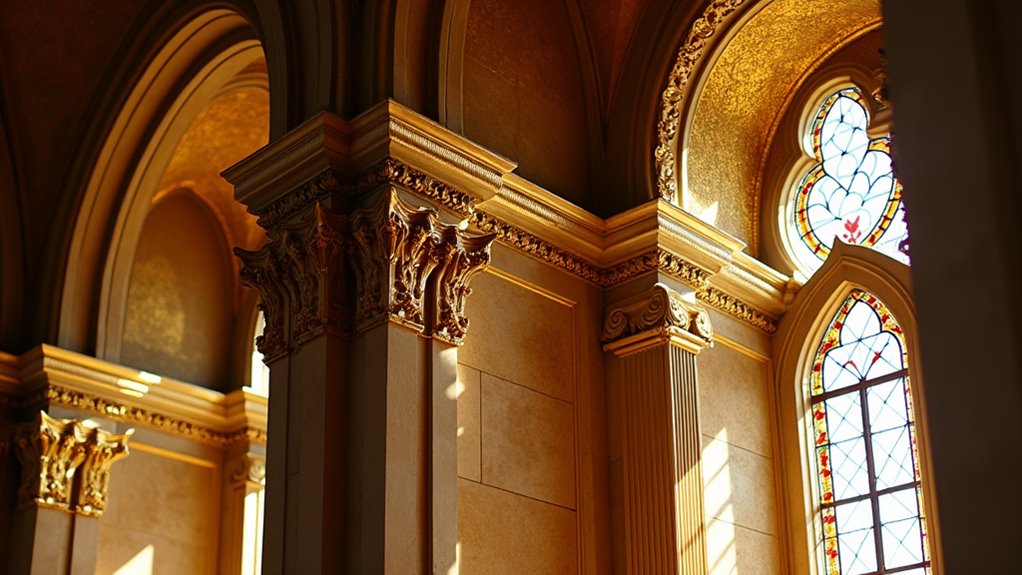
Christianity incorporated gold into its sacred narratives and religious architecture. The biblical account of the Magi’s gifts includes gold alongside frankincense and myrrh, while illuminated manuscripts were embellished with gold leaf to signify holiness. The description of heaven’s streets being paved with gold serves as a powerful metaphor for eternal glory.
Islamic traditions have embraced gold’s sacred qualities through intricate Qur’anic manuscripts and mosque decorations, though its use in personal adornment has been subject to varying interpretations. The metal’s presence in geometric designs and sacred text bindings symbolises divine beauty and eternal spiritual truths.
Hindu traditions associate gold with prosperity and divine presence, particularly through its connection to goddesses Lakshmi and Saraswati. The metal features prominently in temple decorations, wedding ceremonies, and sacred art, where it is believed to bring good fortune and symbolise immortality.
The ancient Greeks and Romans similarly viewed gold as a symbol of divine favour, incorporating it into their temples and religious imagery. Mythological tales like the Golden Fleece highlighted gold’s supernatural significance, while priests wore golden ornaments to signify their connection to the divine domain.
Across these diverse traditions, gold’s universal association with the sun has contributed to its enduring spiritual significance. Its unchanging lustre and resistance to corrosion have made it a natural symbol for eternal truth and divine presence, transcending cultural boundaries and historical epochs to maintain its position as humanity’s most revered precious metal. Additionally, gold’s representation of power has been a consistent theme, illustrating its importance across various civilizations and their belief systems.
Ancient civilisations employed various methods to purify and authenticate gold.
Thermal techniques like cupellation involved heating gold with lead to separate impurities, while chemical processes utilised salt and acids to dissolve non-gold metals.
For testing authenticity, they relied on gold’s unique properties – its malleability was assessed through hammering, while the ‘trial by fire’ verified its melting point and lustre.
Density-based separation, like panning, helped isolate pure gold from debris.
Ancient civilisations consistently used gold in burial practices to signify divine power, wealth and eternal life.
The Egyptians adorned pharaohs with intricate death masks and jewellry, while Mesopotamian royalty were buried with gold weapons and ceremonial items.
In Bulgaria’s Varna Necropolis, the world’s oldest gold artefacts marked social hierarchies, and Pre-Columbian cultures used gold ornaments to denote status.
These practices reflected a universal belief that precious metals accompanied souls into the afterlife.
Archaeological evidence shows that Mesopotamian and Egyptian civilisations were among the first to develop gold plating techniques around 3,000 BCE.
They pioneered methods of applying thin gold layers to artifacts and ceremonial objects.
The Romans later refined these techniques between the 1st and 4th centuries CE, introducing innovations like mercury gilding and displacement plating.
Ancient Chinese artisans independently developed their own sophisticated gilding methods for decorating precious objects.
Gold greatly shaped marriage customs across ancient civilisations.
In Egypt, gold rings symbolised eternal love and divine protection, while Mesopotamian brides received gold as personal property and financial security.
Greeks and Romans used gold rings to represent binding contracts, often personalising them with engravings.
Jewish traditions incorporated gold in marriage contracts and dowries, emphasising the groom’s ability to provide.
These practises established gold’s enduring role in matrimonial traditions.
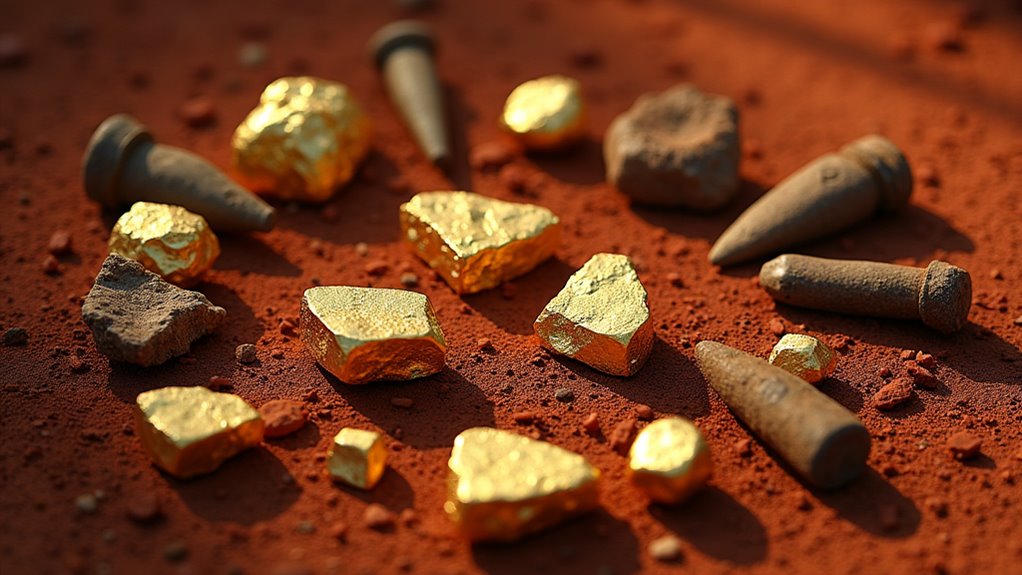
The earliest gold mining tools were remarkably simple yet effective. Ancient civilisations primarily used gold panning, employing wooden or metal pans to separate gold from sediment through careful washing movements.
Stone mortars and mallets were crucial for crushing ore, while basic sluice boxes helped trap gold particles in running water.
In underground mining, bronze and iron picks, chisels, and hammers were essential for breaking gold-bearing rock. The Romans later introduced hydraulic mining using pressurised water systems.
Affiliate Disclosure: This page contains affiliate links to Amazon AU and eBay AU. We may earn a small commission if you purchase through these links, at no extra cost to you.