Affiliate Disclosure: This page contains affiliate links to Amazon AU and eBay AU. We may earn a small commission if you purchase through these links, at no extra cost to you.
As an Amazon Associate I earn from qualifying purchases.

Karat.au is an independent educational resource. The content on this site is provided for general informational purposes only and is not intended as financial, investment, legal, or taxation advice. We do not hold an Australian Financial Services Licence (AFSL), and nothing on this site constitutes a personal recommendation or a substitute for independent professional advice. You should consult a licensed financial adviser or other qualified professional before making any financial decisions.
While we strive to provide accurate and up-to-date information, we make no warranties as to its reliability, currency, or completeness. Karat.au, its authors, and contributors accept no responsibility for any loss or damage arising from reliance on the information provided. For more details, please review our Terms of Use.

Affiliate Disclosure: This page contains affiliate links to Amazon AU and eBay AU. We may earn a small commission if you purchase through these links, at no extra cost to you.
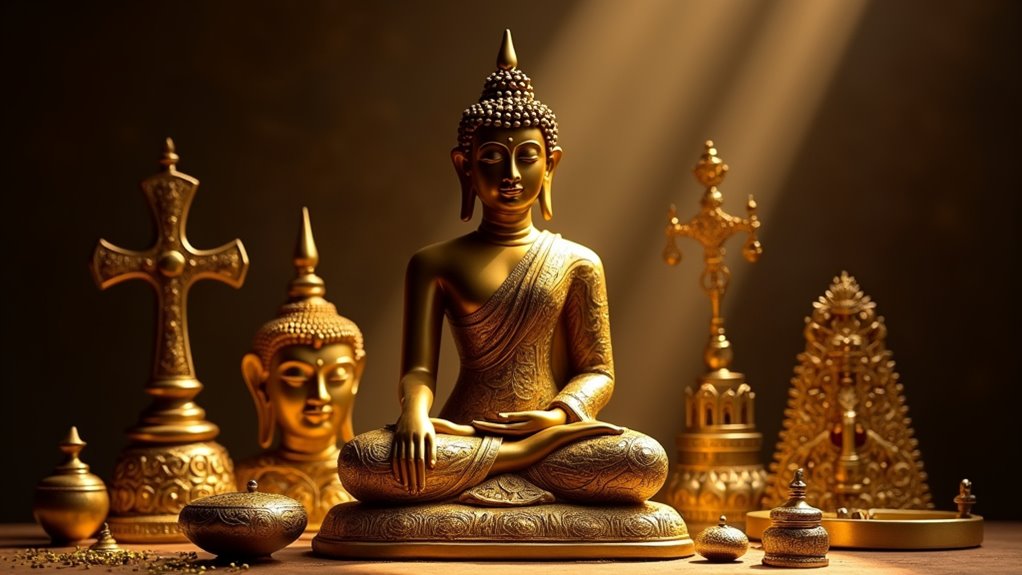
Gold holds profound ceremonial significance across global cultures and religions. Ancient Egyptians crafted elaborate golden death masks, while Hindu temples showcase intricate golden decorations symbolising divine knowledge. Buddhist traditions incorporate gold-plated statues and roofs, while Christian churches feature golden crosses and chalices. From Chinese New Year customs to Indian wedding ceremonies, gold remains central to ritual objects and sacred traditions. The precious metal’s cultural significance spans continents and centuries, revealing fascinating stories of human spirituality.

Throughout human history, gold has maintained an unrivalled position as the most revered metal in ceremonial objects and religious traditions across diverse cultures. From ancient civilisations to modern societies, gold’s enduring presence in sacred rituals and ceremonies reflects its universal significance as a symbol of divine connection, wealth, and spiritual enlightenment. Additionally, gold’s role as a cultural symbol often varies significantly across different societies, showcasing its multifaceted importance. Gold jewelry’s historical significance has been documented through ages as it encapsulates the artistry and craftsmanship of various cultures.
In religious contexts, gold’s brilliance illuminates sacred spaces and objects worldwide. Christian churches showcase golden crosses, chalices, and altars, while Hindu temples feature elaborate golden decorations symbolising spiritual knowledge. Buddhist temples are adorned with gold-plated roofs and statues, embodying the path to enlightenment, and the use of gold in religious artifacts reflects a common desire to convey the divine. Additionally, the push for ethical sourcing has led many cultures to seek responsibly sourced gold for their sacred objects, ensuring the protection of both people and the environment.
Wedding ceremonies across cultures demonstrate gold’s role in marking life’s significant moments. Indian marriages are incomplete without golden jewellery and dowry, believed to bestow blessings of prosperity upon the couple. Middle Eastern weddings feature gold coins and ornaments as symbols of good fortune, while Chinese traditions incorporate golden gifts to guarantee a prosperous future. African tribal ceremonies showcase family wealth through golden adornments, and Western traditions centre on the exchange of gold rings as eternal symbols of commitment.
Cultural festivals and celebrations further highlight gold’s ceremonial importance. During Chinese New Year, gold items are exchanged as tokens of good fortune. Hindu festivals like Diwali see families purchasing gold as an auspicious act. Middle Eastern and African celebrations feature gold prominently in traditional gifting and decorative practices, while Western cultures mark milestones with golden jewellery and commemorative items.
The metal’s association with status and power spans civilisations. Ancient Egyptian pharaohs were entombed with magnificent golden artifacts, believing in their divine significance. Hindu society’s hierarchical structure is often reflected through gold possession, while Middle Eastern cultures view it as a measure of social prestige. European monarchies historically used golden crowns and regalia to symbolise authority, and African traditions incorporate gold to display power during ceremonial rituals.
In death and remembrance, gold continues its sacred role. Ancient Egyptian funerary practices included elaborate golden masks and burial items, most famously exemplified by Tutankhamun’s death mask. Hindu ceremonies involve offering golden coins to assist the departed soul’s journey, while Chinese traditions include burning gold paper offerings for ancestral spirits. Additionally, the sacred significance of gold in world religions highlights its enduring devotion across cultures.
Contemporary Western practices sometimes incorporate gold in caskets and memorial objects, reflecting enduring respect for the deceased and maintaining gold’s timeless connection to humanity’s most profound ceremonial traditions.
Different cultures employ various traditional methods to purify gold for ceremonial objects.
Indian artisans rely on fire smelting and blowpipes, whilst Middle Eastern craftsmen historically favoured salt cementation.
Ancient techniques like cupellation remain relevant, though modernised with precise temperature controls.
In many traditions, the purification process itself carries spiritual significance, particularly for temple idols and religious artefacts where gold’s purity is paramount to its ceremonial purpose.
When religious practices evolve or cease, ceremonial gold objects typically follow three main paths.
They’re often repurposed into new religious artifacts, maintaining their sacred significance while adapting to contemporary worship.
Alternatively, they may be transformed into secular items like jewelry or sold to fund community needs.
Museums and archives frequently preserve historically significant pieces, ensuring their cultural heritage endures whilst educating future generations about religious traditions.
Damaged ceremonial gold objects can indeed be restored while preserving their spiritual significance through careful techniques and cultural sensitivity.
Traditional methods like Kintsugi actually enhance spiritual meaning by celebrating imperfections. Using original materials such as natural lacquers and authentic gold powders helps maintain spiritual integrity.
However, success depends on proper consultation with cultural authorities and adherence to specific traditions that honour the object’s sacred purpose.
Modern artisans employ a sophisticated blend of ancient and contemporary techniques to recreate ceremonial goldwork.
They utilise traditional methods like granulation and filigree, enhanced by laser welding and 3D modelling.
Lost-wax casting is modernised through vacuum systems, while precise temperature control enables authentic finishes.
Craftspeople study historical pieces under microscopes to understand original techniques, adapting them with today’s tools whilst maintaining the integrity of ancestral methods.
The world’s oldest known gold ceremonial objects, discovered in the Varna Necropolis of Bulgaria, are primarily housed in the National Archaeological Museum in Sofia.
Dating to approximately 4,600-4,200 BCE, these precious artefacts include intricate beads, bracelets, and ceremonial sceptres.
While some pieces occasionally tour internationally, the bulk of the collection, weighing over 6 kilos, remains securely preserved in Sofia, where it continues to draw researchers and visitors from across the globe.
Affiliate Disclosure: This page contains affiliate links to Amazon AU and eBay AU. We may earn a small commission if you purchase through these links, at no extra cost to you.