Affiliate Disclosure: This page contains affiliate links to Amazon AU and eBay AU. We may earn a small commission if you purchase through these links, at no extra cost to you.
As an Amazon Associate I earn from qualifying purchases.

Karat.au is an independent educational resource. The content on this site is provided for general informational purposes only and is not intended as financial, investment, legal, or taxation advice. We do not hold an Australian Financial Services Licence (AFSL), and nothing on this site constitutes a personal recommendation or a substitute for independent professional advice. You should consult a licensed financial adviser or other qualified professional before making any financial decisions.
While we strive to provide accurate and up-to-date information, we make no warranties as to its reliability, currency, or completeness. Karat.au, its authors, and contributors accept no responsibility for any loss or damage arising from reliance on the information provided. For more details, please review our Terms of Use.
Affiliate Disclosure: This page contains affiliate links to Amazon AU and eBay AU. We may earn a small commission if you purchase through these links, at no extra cost to you.
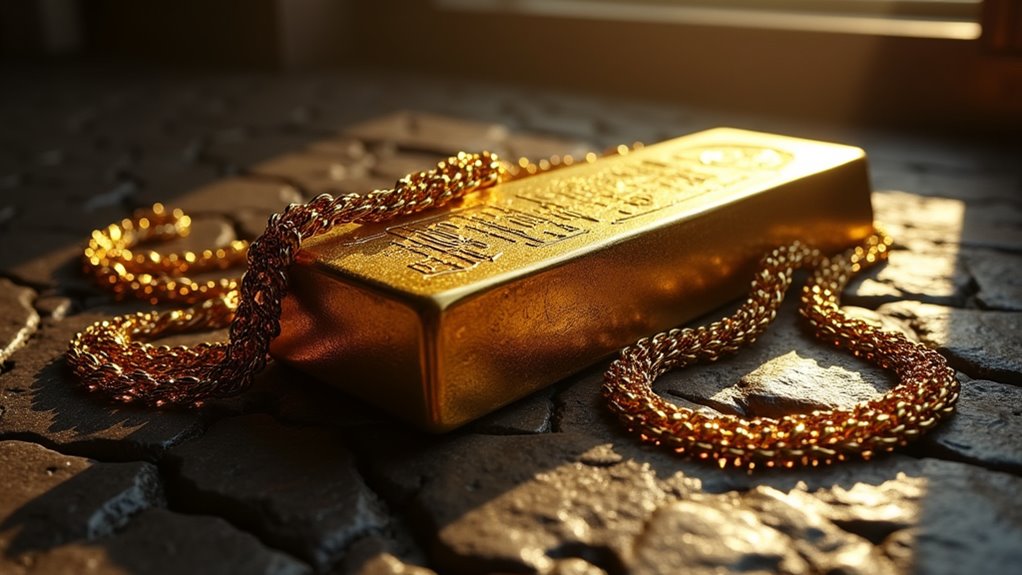
Gold’s mythological significance spans diverse ancient civilisations, from Egyptian pharoahs who saw it as the “flesh of the gods” to Incan temples honouring their sun deity Inti. This precious metal consistently symbolised divine power, spiritual enlightenment, and material wealth across cultures. Its resistance to corrosion and brilliant lustre made it ideal for sacred texts, ceremonial objects, and royal regalia. The deeper cultural meanings of gold continue to shape its enduring value today.

Throughout the ages, gold has captivated humanity’s imagination, weaving itself into the rich tapestry of mythological narratives and religious symbolism across diverse civilisations. In ancient Egypt, this precious metal was revered as the “flesh of the gods,” particularly associated with Ra, the sun god, while the Incas honoured their sun deity Inti through magnificent golden temples like Coricancha. Hindu mythology similarly embraced gold as a divine treasure, emerging from the cosmic ocean during the Samudra Manthan. Gold jewelry has also been integral to various ceremonial use that further highlights its cultural significance, including its presence in sacred objects used in rituals across many cultures.
The solar connections of gold run deep through cultural histories, with its radiant properties mirroring the eternal energy of the sun. Egyptian pharaohs were entombed in golden sarcophagi to guarantee their journey through the afterlife, while the Incas poetically referred to gold as the “sweat of the sun,” believing it created a bridge between mortal and divine domains. This celestial association pervaded numerous ancient civilisations, from Mesopotamia to the Indian subcontinent.
Mythological tales across cultures have woven gold into their narrative fabric. Norse mythology tells of Sif’s golden hair symbolising fertility and abundance, while Celtic legends speak of Dagda’s magical golden cauldron representing eternal nourishment. Greek mythology, too, featured gold prominently in epic tales such as the quest for the Golden Fleece, perpetuating its status as a material of divine origin.
As a symbol of wealth and power, gold has consistently represented the pinnacle of material prosperity and social status. Kings and rulers throughout history adorned themselves with golden crowns, sceptres, and regalia to manifest their divine authority. In Mesoamerican cultures, particularly among the Aztecs, gold transcended mere decoration to become a powerful emblem of both political and spiritual supremacy. Medieval European nobility similarly measured their magnificence through their golden possessions.
The spiritual significance of gold extends into ceremonial practices and religious iconography. Buddhist temples incorporate gold to represent enlightenment, while Hindu temples feature it extensively in honouring deities like Lakshmi. Its resistance to corrosion made it an ideal medium for preserving sacred texts and eternal truths, while its brilliant lustre came to symbolise spiritual illumination across various faith traditions. The use of gold in sacred architecture also highlights its importance in creating spaces that elevate the divine experience.
In ritual practices, gold has played a pivotal role in marking life’s significant moments. From wedding ceremonies to birth celebrations, the exchange of gold has symbolised blessings and good fortune. Its presence in burial rites, particularly elaborate in ancient Egyptian practices, underscored its association with immortality and divine favour.
The metal’s perceived indestructibility and unchanging nature have consistently reinforced its status as a bridge between the temporal and eternal domains, making it an enduring symbol of both material wealth and spiritual transcendence.
Different cultures employ various systems to measure gold purity.
Western nations commonly use the karat system (24 parts) or millesimal fineness (parts per thousand).
Asian markets prefer the stricter Chuk Kam standard, requiring 99% purity.
Russia utilises the zolotnik system, while Middle Eastern and Indian cultures traditionally favour high-purity standards of 22-24 karats.
Each system is supported by national hallmarking authorities and testing procedures for quality assurance.
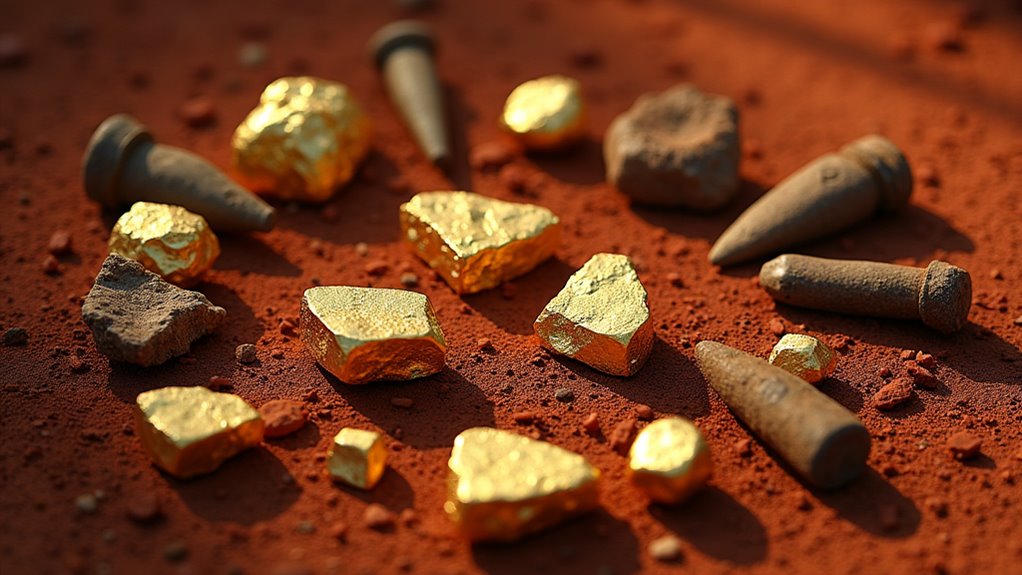
Several ancient gold mining techniques remain relevant in modern mining operations.
Panning and sluicing continue to be effective methods, particularly in artisanal mining throughout Africa and South America.
Hard rock shaft mining, though now enhanced with modern equipment, follows similar principles pioneered by ancient civilisations.
Hydraulic mining, first used by the Romans, has evolved into today’s high-pressure systems, while traditional gravitational separation still underpins many contemporary extraction processes.
While multiple ancient civilisations developed gold smelting independently, evidence suggests the earliest documented gold smelting occurred in ancient Egypt around 2450 BCE in Nubia.
However, archaeological findings indicate that Mesopotamian cultures may have experimented with similar techniques even earlier.
The precise origin remains debatable, as several civilisations, including those in the Andes and Asia Minor, developed their unique smelting methods within similar timeframes.
Gold profoundly shaped early civilisations’ trading networks by serving as a universally accepted medium of exchange.
Its standardisation through coinage, particularly after the Lydians’ innovations in the 7th century BCE, facilitated reliable cross-border commerce.
The trans-Saharan trade routes flourished as West African gold reached Mediterranean markets, while trade hubs like Kumbi Saleh emerged along these routes.
Gold’s durability and inherent value fostered trust between distant cultures, catalysing economic integration and urbanisation.
Gold played a significant role in ancient medical practices across multiple civilisations.
Chinese practitioners used gold needles in acupuncture and treatments for various ailments like tuberculosis.
Egyptian physicians ground gold into powder for healing concoctions, while Greco-Roman doctors prescribed it for balancing bodily humours and treating melancholy.
In medieval Islamic medicine, gold was valued for strengthening the heart and calming anxiety, often administered through gold filings dissolved in water.
Affiliate Disclosure: This page contains affiliate links to Amazon AU and eBay AU. We may earn a small commission if you purchase through these links, at no extra cost to you.