Affiliate Disclosure: This page contains affiliate links to Amazon AU and eBay AU. We may earn a small commission if you purchase through these links, at no extra cost to you.
As an Amazon Associate I earn from qualifying purchases.

Karat.au is an independent educational resource. The content on this site is provided for general informational purposes only and is not intended as financial, investment, legal, or taxation advice. We do not hold an Australian Financial Services Licence (AFSL), and nothing on this site constitutes a personal recommendation or a substitute for independent professional advice. You should consult a licensed financial adviser or other qualified professional before making any financial decisions.
While we strive to provide accurate and up-to-date information, we make no warranties as to its reliability, currency, or completeness. Karat.au, its authors, and contributors accept no responsibility for any loss or damage arising from reliance on the information provided. For more details, please review our Terms of Use.

Affiliate Disclosure: This page contains affiliate links to Amazon AU and eBay AU. We may earn a small commission if you purchase through these links, at no extra cost to you.
Gold held immense significance across ancient Asian civilisations, serving as both a symbol of divine authority and economic power. In Imperial China, it represented status alongside jade and silk, while Southeast Asian kingdoms viewed it as a connection to spiritual enlightenment. Ancient craftsmen developed sophisticated goldsmithing techniques, creating intricate designs for temples, palaces, and ceremonial objects. The precious metal’s influence on political structures and religious practices reveals fascinating layers of cultural complexity that shaped these societies’ development.

While precious metals have shaped countless civilisations throughout history, gold held an unparalleled position of reverence across ancient Asian cultures. Its significance extended far beyond mere economic value, permeating every aspect of society from religious ceremonies to political power structures. In ancient China, gold stood alongside bronze, jade, and silk as a paramount symbol of status, while throughout Southeast Asia, it became intrinsically linked with divine authority and spiritual enlightenment. The exploitation of gold often mirrored the dark history of colonialism, revealing the lengths to which societies would go to acquire this precious metal.
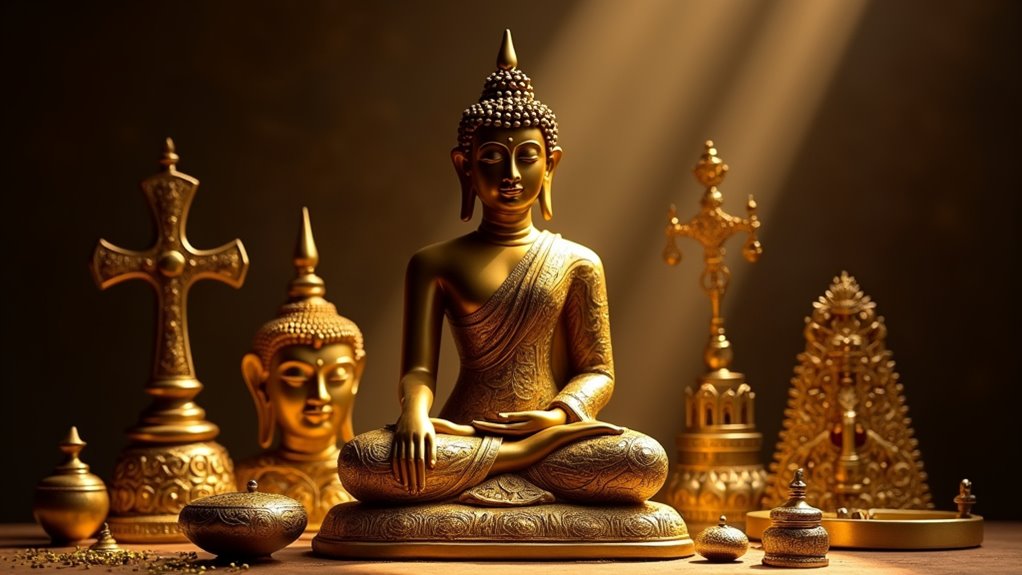
The connection between gold and spirituality was particularly profound in Asian religious traditions. Buddhist temples incorporated gold-wrapped threads and precious leaf in their sacred sutras, while Hindu influences spread throughout Southeast Asia, encouraging the use of gold to represent divine authority. Kings and queens adorned themselves in golden regalia, positioning themselves as earthly manifestations of deities, while temples and sacred spaces were sanctified through the presence of this precious metal. The sacred role of gold in ancient civilizations often mirrored its spiritual significance in Asia, where it was frequently regarded as a symbol of divinity in various sacred texts. The use of gold in religious artifacts further exemplified its integral role in rituals and worship across these cultures.
Ancient Asian civilisations developed sophisticated techniques in goldsmithing that reflected their cultural values and artistic sensibilities. Craftsmen combined gold with precious gems, creating intricate designs that spoke of perfection and immortality. In imperial China, specialised artisans produced refined gold calligraphy for both religious and secular scrolls, while Southeast Asian cultures developed distinctive jewellery styles that merged local traditions with Indian influences. The dedication to ethical gold sourcing in the production of these jewels also began to emerge as a valued practice in these ancient societies.
Ancient Asian goldsmiths mastered their craft through intricate designs and spiritual symbolism, blending cultural traditions to create timeless treasures of unparalleled beauty.
The acquisition and control of gold played a pivotal role in shaping political and economic structures. During the Ming dynasty, strict laws limited gold usage to imperial families and court officials, reinforcing social hierarchies and concentrating power. The Silk Road facilitated the exchange of not just gold artifacts but also techniques and cultural practices between East and West, creating a complex network of trade relationships that sustained these ancient economies.
The legal framework surrounding gold ownership and production reflected its immense cultural significance. Ancient Chinese laws imposed severe penalties, including death, for unauthorized gold acquisition during the Zhou dynasty. These regulations weren’t merely economic measures; they represented the broader social order and the careful balance of power between rulers and subjects.
Throughout Asia, gold enriched both the material and spiritual aspects of civilisation. It adorned palaces and temples, enhanced sacred texts and ceremonial objects, and served as a medium for artistic expression. The mastery of goldsmithing techniques, from chasing to filigree and gilding, demonstrated the technical sophistication of ancient Asian craftsmen, while the careful regulation of gold resources helped maintain political stability and social order.
This precious metal’s enduring legacy continues to influence our understanding of ancient Asian cultures and their achieved refinement in both artistic and spiritual pursuits.
Ancient Asian civilisations employed sophisticated methods to verify gold purity. The fire assay technique, documented from 1380 BCE, involved heating metals to separate noble from base components using nitric acid.
Early chemical processes included dissolving metals and observing flame absorption patterns.
Southeast Asian cultures combined visual inspection of panned gold under sunlight with these technical approaches.
Multiple refinement cycles were common, particularly for gold destined for royal or religious purposes.
Ancient Asian gold mining employed diverse techniques and tools. Miners used stone hammers and chisels for extracting ore from quartz veins, while wooden pans and sluice boxes were essential for alluvial mining in rivers.
Fire-setting was practised to crack hard rock formations, and grinding stones pulverised ore for processing. In Southeast Asia, clay-lined pits aided gold recovery, while organised labour teams worked systematically to extract the precious metal from deposits.
Based on historical records, the Lydian Kingdom in Asia Minor (modern-day Turkey) pioneered the first standardised gold currency system around the 7th century BCE.
While ancient Chinese civilisations like the Qin Dynasty later developed their own gold currency called “yì,” and Mesopotamian societies used gold bars as proto-currency, the Lydians are credited with creating the earliest formal gold coinage system that influenced monetary developments across Asia.
Gold trading routes across Asia served as powerful catalysts for cultural exchange.
Along paths like the Silk Road and Sichuan-Yunnan corridor, merchants exchanged more than precious metals – they shared technological innovations in metallurgy, religious philosophies, and artistic styles.
These routes fostered the development of major cultural centres like Xi’an and Wari-Bateshwar, while facilitating diplomatic relationships through gold gifts and establishing lasting connections between civilisations.
Gold played an essential role in ancient Asian medical practices, particularly in Chinese and Indian traditions.
In Chinese medicine, gold acupuncture needles were used to stimulate qi flow, while “gold juice” was prescribed for various ailments.
In Ayurvedic medicine, “Swarna” was incorporated into treatments for boosting immunity and longevity.
The precious metal was commonly ground into powder or melted for medicinal concoctions, reflecting its significance in traditional healing practices across Asia.
Affiliate Disclosure: This page contains affiliate links to Amazon AU and eBay AU. We may earn a small commission if you purchase through these links, at no extra cost to you.