

Gold occupied a central position in ancient Mesopotamian civilisation, despite not being naturally abundant in the region. Through extensive trade networks with Anatolia, Egypt, and Persia, Mesopotamians acquired this precious metal, which became deeply woven into their social fabric. Skilled goldsmiths crafted intricate pieces for religious ceremonies and elite display, while the metal’s presence in temples and tombs reflected both divine connections and social hierarchy. The fascinating story of Mesopotamian gold continues to reveal layers of cultural significance.

While gold was not naturally abundant in ancient Mesopotamia, its profound influence on the region’s civilisation cannot be overstated. The ancient Mesopotamians acquired their gold primarily through trade networks extending to Anatolia, Egypt, and Persia, leveraging their strategic position along major trade routes. Through both direct exchange and tribute systems with neighbouring states, they maintained a steady supply of this precious metal that would become integral to their society’s fabric. The prominence of gold in Mesopotamia also laid the groundwork for its later role in global currency systems, which were often influenced by the availability and desirability of gold.
The craftmanship of Mesopotamian goldsmiths was remarkable, demonstrating sophisticated techniques in creating intricate pieces that ranged from delicate filigree jewelry to elaborate ceremonial objects. These artisans employed archaic tools and methods, including hammering and engraving, to transform raw gold into masterpieces that adorned palaces, temples, and the elite. Their technical expertise resulted in highly-prized artifacts that continue to captivate modern observers, reflecting the cultural significance of gold jewelry across various traditions. Notably, their work often featured motifs and designs that echoed the mythical allure of gold, further enhancing its desirability.
The religious significance of gold in Mesopotamian culture was paramount. Considered sacred and divine, gold decorated temples and religious artifacts, symbolising the eternal and incorruptible nature of the gods. Religious ceremonies frequently incorporated golden objects as offerings, while temples featured golden ornaments to emphasise their celestial connections. This spiritual association elevated gold beyond mere precious metal to a medium of divine communication, reinforcing its status as a form of sacred currency used in various ancient cultures.
In Mesopotamian society, gold served as a powerful indicator of social status and economic might. The wealthy and royal classes distinguished themselves through gold-laden attire and accessories, while the presence of gold artifacts in tombs reflected the deceased’s social standing. These burial practices not only highlighted the society’s beliefs about the afterlife but also preserved evidence of their sophisticated social hierarchy.
The cultural impact of gold extended beyond its material value, embodying concepts of immortality and divine favour. Intricate designs on gold artifacts showcased not only Mesopotamian aesthetic values but also their understanding of symbolism and artistic expression. These pieces often became family heirlooms, passed down through generations, cementing gold’s role in preserving cultural heritage and maintaining social prestige.
Despite not being indigenous to the region, gold’s influence permeated every aspect of Mesopotamian civilisation. From its role in international trade and diplomacy to its use in religious rituals and social stratification, gold helped shape one of history’s earliest complex societies. The sophistication of Mesopotamian goldwork, combined with its cultural and religious significance, demonstrates how this precious metal transcended its material worth to become a fundamental element of ancient Mesopotamian identity and achievement. Additionally, the legacy of gold jewelry craftsmanship from this era continues to inspire modern artisans and jewelers around the world.
Frequently Asked Questions
How Did Ancient Mesopotamians Determine the Purity of Their Gold?
Ancient Mesopotamians employed several sophisticated methods to determine gold purity. They utilised alloying techniques, mixing gold with other metals to observe colour and ductility changes.
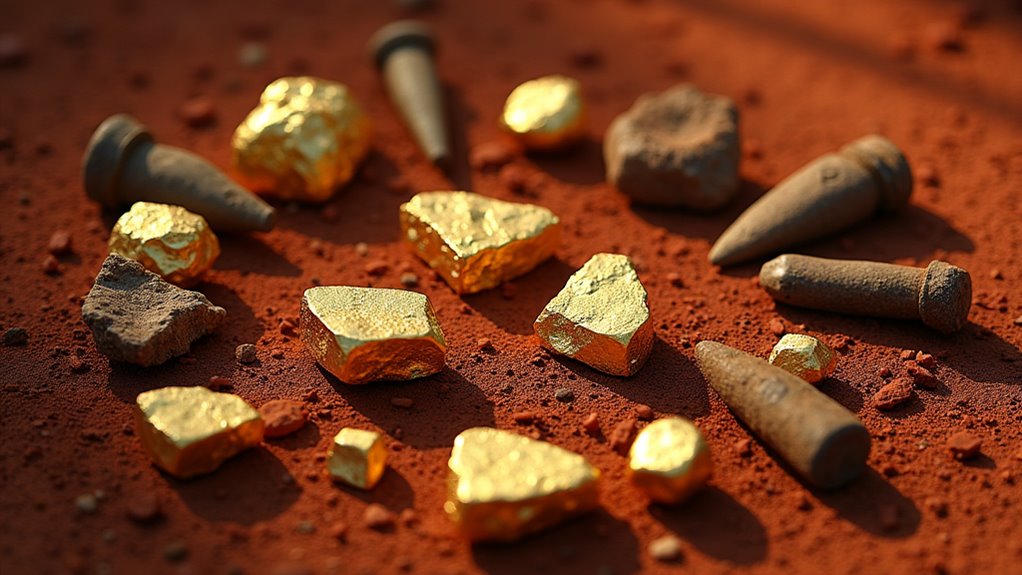
Visual assessments focussed on the metal’s lustre and surface characteristics, while touchstone testing compared gold streaks against known standards.
Additionally, they refined gold through smelting processes, documenting weight losses to track purification. Their quantification system expressed purity through weight ratios and standardised classifications.
What Tools and Techniques Did Mesopotamians Use to Mine Gold?
Ancient Mesopotamians employed several sophisticated mining techniques to extract gold. They used stone tools like flint chisels and hammers to break gold-bearing rocks, while implementing the fire-setting method to crack ore deposits through controlled heating and cooling.
For alluvial gold, they utilised simple but effective placer mining with sluice boxes and panning techniques. Their refining process involved smelting in crucibles with reed pipes to reach temperatures of 1,100°C.
Did Mesopotamians Trade Gold With Other Ancient Civilizations Beyond Their Region?
Mesopotamians actively traded gold with numerous ancient civilisations, establishing extensive networks across the ancient world.

They maintained robust trading relationships with the Indus Valley, Egypt, and Anatolia through both land and maritime routes.
Archaeological evidence, including the Golden Lyre of Ur and various artefacts, confirms these international exchanges.
Gold served as both currency and a luxury commodity, while temples and merchants controlled much of this valuable trade throughout the region.
How Did Common People View Gold Compared to the Elite Classes?
Common people viewed gold with mystical reverence, seeing it as a divine substance beyond their reach.

While elites used gold practically to display wealth and power through jewellery, weapons, and ceremonial items, ordinary Mesopotamians encountered gold mainly in temples and religious settings.
The stark contrast reflected social hierarchies – elites manipulated gold’s sacred associations to reinforce their authority, while commoners remained in awe of its splendour and unattainability.
What Role Did Gold Play in Mesopotamian Religious Ceremonies and Rituals?
Gold played a central role in Mesopotamian religious ceremonies, symbolising divine power and eternal life.
Temples housed golden statues and ritual objects, while priests used gold vessels during sacred offerings.
During festivals like Akitu, golden decorations adorned processional statues and shrines.
The precious metal’s presence in religious rituals reinforced the connection between worshippers and deities, while also serving as a symbol of divine authority and kingship.


