

Gold’s architectural legacy spans over 8,000 years, from ancient Turkish settlements to modern-day skyscrapers. This precious metal has adorned religious structures like Byzantine churches and Buddhist temples, symbolising divine presence and spiritual transcendence. Throughout history, royal residences like Versailles and the Forbidden City showcased gold’s association with power and prestige. Today’s designers embrace subtle gold finishes in minimalist aesthetics, maintaining its timeless significance in contemporary spaces. The journey of gold’s architectural influence reveals fascinating chapters of human civilisation.

Throughout human history, gold has held an unrivalled position in architectural and interior design, transcending its role as mere decoration to become a powerful symbol of divinity, wealth, and cultural significance. The practise of incorporating gold into buildings dates back over 8,000 years to Turkey, where artisans first developed gold leaf application techniques that would later spread throughout ancient civilisations, particularly flourishing in Egypt where it adorned temples, monuments, and tombs dedicated to gods and pharaohs.
Gold’s millennia-long legacy in architecture transforms spaces into symbols of divine power and cultural achievement, enriching humanity’s greatest monuments.
The religious significance of gold in architecture cannot be overstated. From Byzantine churches to Gothic cathedrals, gold became synonymous with divine presence and spiritual transcendence. The material’s ability to reflect and manipulate light made it particularly effective in creating awe-inspiring spaces that connected worshippers to the divine domain. Islamic architecture embraced gold in its elaborate calligraphy and magnificent domes, while Hindu and Buddhist temples incorporated the precious metal into shrines and stupas as expressions of devotion. Moreover, gold is often referenced in sacred texts as a representation of purity and divine glory, highlighting its spiritual symbolism across different cultures. The use of gold in these contexts often reflects the sacred use of gold in ancient religious art, signifying its role in connecting the material and spiritual worlds. Additionally, the use of gold in architectural design is often seen as a reflection of cultural significance, as it embodies the values and beliefs of the society that created it.
Royal residences and palaces exemplified gold’s association with power and prestige. The Palace of Versailles stands as perhaps the most renowned example, with its extensively gilded gates, ceilings, and furnishings showcasing the French monarchy’s grandeur. Similarly, the Chinese Forbidden City’s golden roofs and the ornate interiors of Mughal palaces in India demonstrated how ruling classes across cultures utilised gold to assert their authority and wealth.

The evolution of decorative arts saw gold playing a central role in various design movements. The opulent Baroque and Rococo periods embraced elaborate gilding in furniture, wall panels, and architectural elements. Later, the Art Deco movement of the 1920s reinterpreted gold’s application through geometric patterns and metallic accents, creating a modern expression of luxury that influenced everything from skyscrapers to theatre interiors.
Gold domes have become particularly iconic in sacred architecture worldwide. The Dome of the Rock in Jerusalem pioneered this architectural feature, while Russian Orthodox churches later adopted gold-covered onion domes as their signature element. These gleaming structures continue to serve as powerful symbols of spiritual elevation and divine presence in contemporary religious architecture.
In modern times, gold maintains its status as a symbol of prosperity and refinement, though its application has evolved to suit contemporary tastes. Today’s designers often opt for subtle gold finishes that complement minimalist aesthetics while retaining the material’s inherent luxuriousness. From boutique hotels to corporate headquarters, gold continues to convey prestige and permanence, proving that its architectural significance extends far beyond its monetary value to embed itself deeply in human cultural expression.
Frequently Asked Questions
What Alternatives to Real Gold Are Used in Modern Architectural Design?
Modern architectural design employs several cost-effective alternatives to real gold.
Metallic materials like brass and bronze offer durability while mimicking gold’s warm tones. Titanium provides a contemporary aesthetic with its silver-gold finish, whilst copper delivers similar warmth with unique patination.
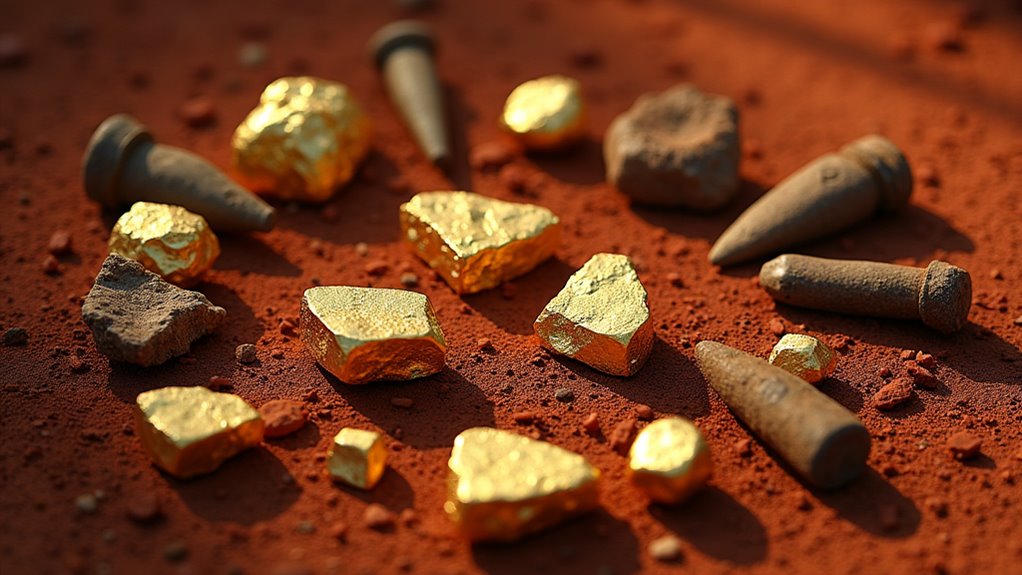
Various finishes including gold-plated coatings, powder coating, and anodised aluminium create golden effects.
Non-metallic options like specialised paints and films provide affordable solutions for decorative elements.
How Do Different Cultures View Gold Symbolically in Their Architectural Traditions?
Different cultures universally celebrate gold’s spiritual significance in their architectural heritage.
Ancient Egyptians adorned temples with gold to honour their deities, while Buddhist traditions incorporate golden stupas to symbolise enlightenment.

The Sikh Golden Temple reflects divine radiance and spiritual fulfilment, and Christian cathedrals feature gold-leafed domes and altars representing heavenly glory.
In Hinduism, gold-decorated temples honour Lakshmi, the goddess of prosperity and abundance.
Can Gold Architectural Elements Be Safely Cleaned Without Causing Damage?
Gold architectural elements can be safely cleaned with proper techniques and precautions.
Using soft microfibre cloths and minimal moisture helps protect delicate surfaces, while avoiding harsh chemicals and abrasive materials prevents damage.

Regular, gentle dusting with specialised tools like cosmetic sponges or soft brushes is recommended for maintenance.
For valuable or historical pieces, it’s advisable to consult professional conservators who understand the unique requirements of preserving gold finishes.
How Does Climate Affect the Durability of Gold Architectural Features?
Climate considerably impacts gold architectural features through various environmental stresses.
Temperature extremes can cause expansion and contraction, potentially weakening connections between gold and supporting materials. High humidity accelerates corrosion in gold alloys, while wind-driven debris may cause surface abrasion.
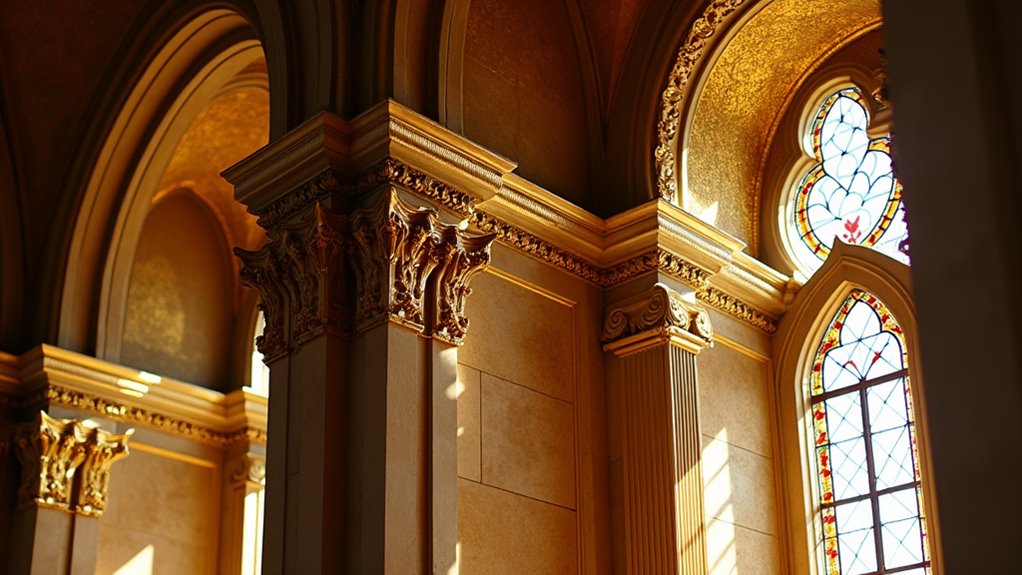
Acidic precipitation, though gold resists oxidation, can erode underlying attachments. Climate change further complicates preservation efforts by introducing more frequent extreme weather events and unpredictable conditions.
What Modern Techniques Are Used to Apply Gold in Contemporary Buildings?
Contemporary buildings employ several sophisticated techniques for gold application.
Advanced oil and water gilding methods allow precise application of gold leaf sheets, while innovative adhesive technologies enable efficient large-scale installations.
Perforated metal alloys and gold-coated panels create dynamic facades, often incorporating sustainable features.

Shell gold techniques facilitate intricate detailing, and digital tools guarantee precise customisation.
Modern buildings also utilise gold’s reflective properties through specialised coatings for energy efficiency.


