
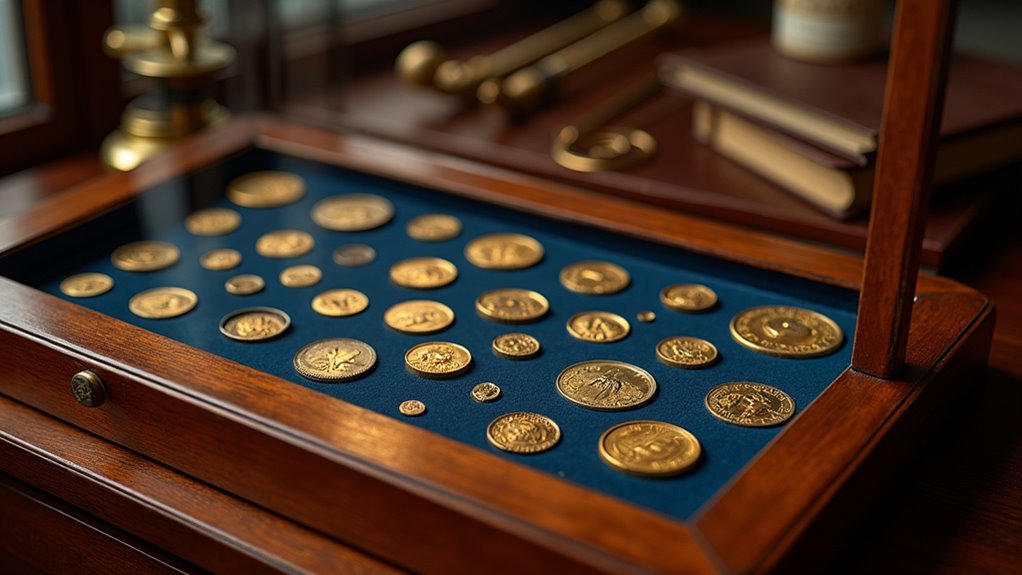
The Nazi Gold Train legend captivates with tales of hidden treasure—gold, jewels, and art—rumoured to be stashed near Wałbrzych, Poland, since World War II. This myth, tied to secretive Nazi projects, has spurred countless searches, yet no loot’s been found. At Karat.au, we’re fascinated by such stories, echoing Australia’s own gold rush dreams. While the train remains a mystery, its allure mirrors gold’s timeless value. Stick with us to uncover more intriguing insights!

While tales of hidden treasure often spark the imagination, the legend of the Nazi Gold Train stands as one of history’s most intriguing mysteries. Emerging after World War II, this urban legend whispers of an armoured train packed with gold, jewels, art, and weapons, hidden by retreating Nazis in late 1944 or early 1945. Rumoured to be concealed in southwest Poland near Wałbrzych, once known as Waldenburg, the tale suggests the train lies sealed in a tunnel or mine, its glittering cargo untouched.
At Karat.au, we’re captivated by such stories of precious loot, much like the golden heritage of Australia’s own mining past, and we’re here to unpack this enigma with clarity and a passion for all things valuable. The enduring importance of gold reserves in today’s economy further amplifies the allure of such legends, as they can significantly influence investor confidence and market stability. Gold has historically served as a reliable asset in portfolios, providing a hedge against inflation and economic downturns. In times of economic uncertainty, the demand for gold often rises, reinforcing its role as a safe haven asset.
Theories point to a specific spot around the 65th kilometre of the Wrocław–Wałbrzych railway line, possibly tied to the shadowy Nazi “Project Riese” in the Owl Mountains. This secretive construction, built with forced labour, carved out vast underground bunkers and tunnels for purposes still debated—perhaps a headquarters or weapons hub. Some even link the train to tunnels beneath Książ Castle, imagining over 300 tonnes of gold and looted masterpieces, including bits of the fabled Amber Room, stashed away.

Yet, despite the allure, these ideas rest on speculation, much like early gold rush yarns in Australia’s outback, where hope often outshone hard evidence.
Searches for this elusive treasure began soon after 1945, with the Polish Army scouring during the Cold War and countless treasure hunters chasing whispers over decades. Anecdotes, like a 1970s tale from a German man to local Tadeusz Slowikowski, fuelled the fire, but no train ever surfaced.
Then, in 2015, two men—Piotr Koper and Andreas Richter—claimed a breakthrough near kilometre 65, citing radar images and a deathbed confession. A media storm erupted, drawing global attention and a flood of fortune-seekers, while the Polish government eyed a 10% finder’s fee. Initial excitement, backed by a deputy minister’s near-certainty, soon faded though.
Excavations from 2016, supported by military and private funds, dug into the site, only to find natural geology or ice formations—no train, no tunnel. Koper and Richter conceded defeat by 2018. Historians, too, remain sceptical, noting no documents tie a train to Wałbrzych, and evidence suggests looted gold from nearby Breslau went elsewhere.

Still, the legend lingers among enthusiasts, even inspiring a replica armoured train as a tourist draw. In times of geopolitical tensions, the influence of such narratives on gold prices can be significant, as people often turn to precious metals as a safe haven. As a result, the fascination with hidden treasures like the Nazi Gold Train underscores the enduring relevance of gold in global finance.
At Karat.au, we see parallels between this saga and the fever of Australia’s gold rushes—dreams of riches often outpace reality. While we revel in such tales, we’re grounded in factual integrity, ensuring you’re informed about gold’s timeless pull, without offering financial advice. The Nazi Gold Train may be myth, but the lure of treasure, like our nation’s golden legacy, endures. (Oops, nearly wrote ‘endures’ twice there!)
Frequently Asked Questions
What Other Treasures Are Linked to Nazi History?
Beyond well-known tales, Nazi history ties to vast treasures looted during WWII.
Across Europe, gold, silver, and jewels were stolen from banks and citizens, alongside priceless art like Raphael’s works and the Amber Room’s ornate panels.

Hidden in mines and castles, such as Altaussee, these riches—worth billions—remain partly unrecovered.
Karat.au, passionate about gold’s legacy, notes ongoing searches for these historic hauls, citing reputable WWII archives for accuracy.
How Do Treasure Hunters Locate Hidden Nazi Loot?
Treasure hunters seeking hidden Nazi loot employ a mix of historical research and cutting-edge tech. They scour declassified archives, local tales, and wartime diaries for clues to secret stashes.
Ground-penetrating radar and magnetometers help detect buried objects or tunnels, while thermal imaging reveals hidden cavities. Site surveys and cautious excavations follow, often with expert aid to dodge wartime traps.

It’s a meticulous, risky quest for history’s lost riches, mate.
Are There Legal Issues With Claiming Nazi Gold?
Legal issues abound when claiming Nazi gold, as ownership disputes often pit original heirs against governments asserting cultural heritage rights.
International laws, like the Hague Conventions, demand restitution of looted items, yet statutes of limitation and lost documentation complicate claims.
National laws vary, with some countries imposing strict deadlines.

Karat.au notes that traversing these complex legal waters requires diligence, transparency, and respect for history’s painful legacy—ensuring justice ain’t overlooked.
What Technology Aids in Searching for Hidden Treasures?
Searching for hidden treasures relies on cutting-edge technology to uncover the unseen.
Metal detectors, using VLF and PI systems, pinpoint coins and artefacts with precision.
Ground Penetrating Radar (GPR) images subsurface voids and objects, while magnetometry detects ferrous anomalies.

LiDAR maps hidden structures, and drones survey vast areas.
These tools, backed by science, aid treasure hunters in unravelling history’s secrets, blending innovation with the thrill of discovery Down Under.
How Do Myths Influence Modern Treasure Hunts?
Myths profoundly shape modern treasure hunts by sparking curiosity and guiding explorers to specific locales. They weave tales of hidden riches, fueling a passion for discovery across generations.
Often born in times of hardship, these stories offer hope and captivate imaginations. While inspiring hunts with modern tech like GPR, they also challenge searchers with folklore’s haze, risky terrains, and legal hurdles.
Their allure remains undeniably powerful, drivin’ adventure.


